Legal Billing October 20, 2026 8 min read
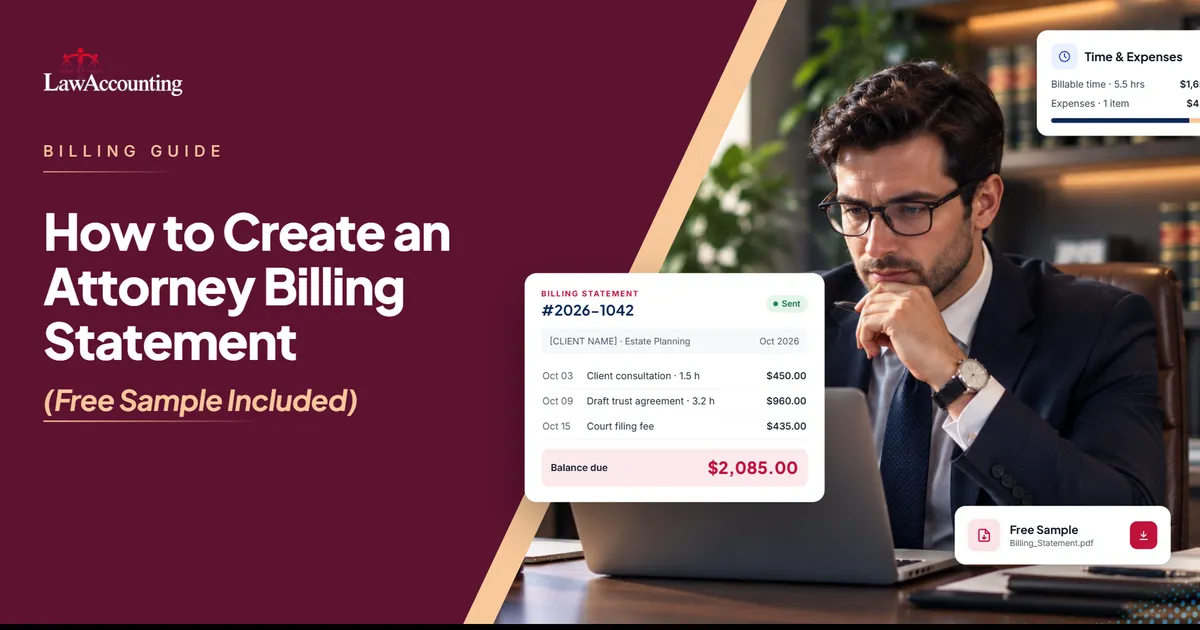
How to Create an Attorney Billing Statement (Free Sample Included)
Published: October 20, 2026
Written by Ramit Kaur · Head of Marketing, LawAccounting
Clients don't usually dispute a bill because of the total. They dispute it because they can't tell what they're paying for. A clear attorney billing statement shows the client exactly what was done, who did it, what it cost, and where their retainer money went. That cuts down on calls, disputes and late payments.
This guide covers what to include in an attorney billing statement, how to write time entries clients accept, and how to show trust activity correctly. There's a free sample statement you can copy, and a short FAQ at the end.
What is an attorney billing statement?
An attorney billing statement is a document a law firm sends to a client that lists the legal work done, the expenses incurred and the amount owed for a billing period. It usually also shows the client's previous balance, payments received and any trust or retainer activity.
Billing statement vs invoice: what's the difference?
An invoice is a request for payment for specific charges. A billing statement is a summary of the client's account over a period, covering past balances, payments, new charges and trust activity. Many law firms send one document that does both, and that's the approach this guide follows.
What should be included in an attorney billing statement?
Every attorney billing statement should include these nine parts.
- Firm details: Firm name, address, phone, email and tax ID if your clients need it.
- Client and matter details: Client name, billing address, matter name and matter number. If a client has more than one matter, use a separate statement or section for each one.
- Statement date and billing period: For example, "Statement date: October 31, 2026. Services through October 31, 2026."
- Itemized time entries: Date, timekeeper, a clear description of the work, hours, rate and amount for each entry.
- Expenses: Filing fees, courier charges, expert fees and other costs, each with a date and description.
- Account summary: Previous balance, payments received, new fees, new expenses and total due.
- Trust account activity: Opening trust balance, amounts applied to this statement and the remaining balance.
- Payment terms: Due date, accepted payment methods and late fee terms if your fee agreement allows them.
- Contact for billing questions: The name and email of the person who handles billing questions.
How to create an attorney billing statement
Step 1: Set the fee terms before any work starts
A good statement starts with the fee agreement. ABA Model Rule 1.5(b) requires lawyers to tell clients the basis of their fees and expenses, preferably in writing, before or soon after the work begins. Agree on rates, billing frequency, how expenses are handled and how trust money will be applied. The statement should then match what the client already agreed to.
Step 2: Record time the same day
Time entered days later is less accurate and usually less detailed. Ask every timekeeper to enter time daily, with the matter and a full description.
Step 3: Write time entry descriptions clients understand
Each time entry description should say what was done and why. Compare these two entries:
Avoid block billing, where several tasks are lumped into one entry with one total time. For example: "Review documents, call client, draft motion. 4.5 hours." The client can't tell how long each task took, so it gets questioned more often. Many corporate clients and insurers refuse to pay block-billed entries at all. If you bill those clients, you may also need to use UTBMS task codes. Our UTBMS codes list explains how they work.
Step 4: Add expenses with receipts on hand
List each expense separately, with the date and what it was for. Keep receipts for anything a client might ask about, especially larger costs like expert fees or deposition transcripts.
Step 5: Show trust and retainer activity clearly
If the client paid a retainer into trust, the statement should show the opening trust balance, how much was applied to this bill and what's left. Under ABA Model Rule 1.15, client money stays in trust until the fee is earned, and you must give the client a full accounting when they ask. Showing trust activity on every statement answers that question before it's asked.
Many states also require you to notify the client when you withdraw earned fees from trust. Check your state's rule.
Step 6: Review the statement before it goes out
Have the responsible attorney or billing lead review each statement. Check for duplicate entries, wrong rates, entries on the wrong matter and vague descriptions. A quick review takes a few minutes and prevents most disputes.
Step 7: Send it on a fixed schedule
Send statements at the same time every month. Clients plan for bills they expect, and a regular schedule keeps unbilled time from piling up.
Free sample attorney billing statement
Copy this sample and adjust it for your firm. The firm and client are fictional.
Harper & Lane LLP
120 Main Street, Suite 400, Springfield
billing@harperlane.example | (555) 010-2200
Client: Jordan Reyes
Matter: Reyes v. Oakline Properties (Matter No. 2026-0148)
Statement date: October 31, 2026
Billing period: October 1 to October 31, 2026
Professional services
| Date | Timekeeper | Description | Hours | Rate | Amount |
|---|---|---|---|---|---|
| Oct 2 | A. Lane, Partner | Review client's lease and draft summary of termination terms | 1.2 | $400 | $480.00 |
| Oct 6 | M. Kim, Associate | Draft demand letter to landlord for return of security deposit | 1.5 | $275 | $412.50 |
| Oct 9 | A. Lane, Partner | Call with client about landlord's response and next steps | 0.4 | $400 | $160.00 |
| Oct 14 | T. Patel, Paralegal | Prepare exhibit binder for mediation | 2.0 | $150 | $300.00 |
| Total fees | 5.1 | $1,352.50 |
Expenses
Account summary
Trust account summary
Payment terms
Payment is due by November 30, 2026. We accept ACH, check and card payments. Questions about this statement? Contact Dana Brooks at billing@harperlane.example.
Attorney billing best practices
- Bill monthly. Long gaps between bills lead to bigger totals and more pushback.
- Use plain language. Write descriptions a client without legal training can understand.
- Keep matters separate. Never combine charges from different matters in one total.
- Make payment easy. Offer more than one way to pay and put a payment link on the statement if you can.
- Follow up on unpaid bills. Send a reminder a few days after the due date, not a few months.
- Keep billing and trust records in sync. If your billing system and trust ledger don't match, your statements won't either.
Frequently asked questions about attorney billing statements
What is an attorney billing statement?
It's a document that shows a client the legal work done, expenses, payments, trust activity and the amount owed for a billing period.
What should be included in an attorney billing statement?
Firm and client details, matter name and number, statement date and period, itemized time entries, expenses, an account summary, trust activity, payment terms and a billing contact.
What is the difference between a billing statement and an invoice?
An invoice asks for payment for specific charges. A billing statement summarizes the account, including previous balances, payments and trust activity. Many firms combine both in one document.
How often should a law firm send billing statements?
Most firms send them monthly. Whatever schedule you pick, put it in the fee agreement and stick to it.
How should trust and retainer activity appear on a client statement?
Show the opening trust balance, the amount applied to the current bill and the closing balance. Only apply funds that have been earned, and follow your state's notice rules.
How detailed should time entry descriptions be?
Detailed enough that the client understands what was done and why. Name the task, the document or person involved, and the purpose.
What is block billing, and why should firms avoid it?
Block billing puts several tasks in one time entry with a single total. Clients can't see how long each task took, so these entries are often disputed or rejected.
Can a law firm charge late fees on unpaid bills?
Often yes, if the fee agreement says so and your state allows it. Some states limit late fees or interest, so check your state bar's rules first.
How can a law firm reduce billing disputes?
Agree on fees in writing, write clear time entries, avoid block billing, show trust activity on each statement and send bills on a regular schedule.
Send statements clients don't need to question
A good attorney billing statement answers the client's questions before they pick up the phone. Set clear fee terms, record time daily, write specific descriptions, show trust activity and review every statement before it goes out. Use the sample above as your starting point.
If your firm's billing, trust and accounting records sit in separate systems, statements take longer to prepare and are harder to get right. LawAccounting keeps billing, trust accounting and the general ledger in one platform, so every statement draws from the same records.