Legal Billing November 23, 2026 10 min read
Billing Increments Chart: 6-Minute Increments for Lawyers (Free Cheat Sheet)
Last updated: November 2026
Written by Ramit Kaur · Head of Marketing, LawAccounting
A billing increment is the smallest unit of time a law firm charges a client for. Most firms bill in 6-minute increments, also called tenths of an hour, so every time entry is recorded as 0.1, 0.2, 0.3, and so on. Some firms use 10-minute or 15-minute increments instead.
The increment your firm picks, and how it rounds, decides how much a client pays for every short call and email. Below you'll find charts for all three increments, a minutes-to-decimal table, what bar opinions say about rounding, and a one-page cheat sheet at the end.
What Are Billing Increments?
Billing increments are the fixed blocks of time lawyers use to record and bill their work. Instead of billing 17 minutes, a lawyer billing in tenths records the nearest block, such as 0.3 hours. The client is then charged that number multiplied by the hourly rate.
The three increments you'll see most often are:
- 6 minutes (0.1 hour), the most common in legal billing
- 10 minutes (about 0.17 hour)
- 15 minutes (0.25 hour), sometimes called quarter-hour billing
Why Do Lawyers Bill in 6-Minute Increments?
Lawyers bill in 6-minute increments because a tenth of an hour is small enough to be fair to clients and simple enough to calculate. Ten increments make an hour, so any entry converts to a decimal without extra math. Billing by the minute would be accurate but tedious to track. Larger increments are easier but can charge clients for time that wasn't worked.
Bar regulators have pointed the same way. In Formal Advisory Opinion 01-1, the State Bar of Georgia noted that many lawyers bill in standard units of 6 to 15 minutes, and said a 6-minute unit is preferable.
6-Minute Increment Chart (Tenths of an Hour)
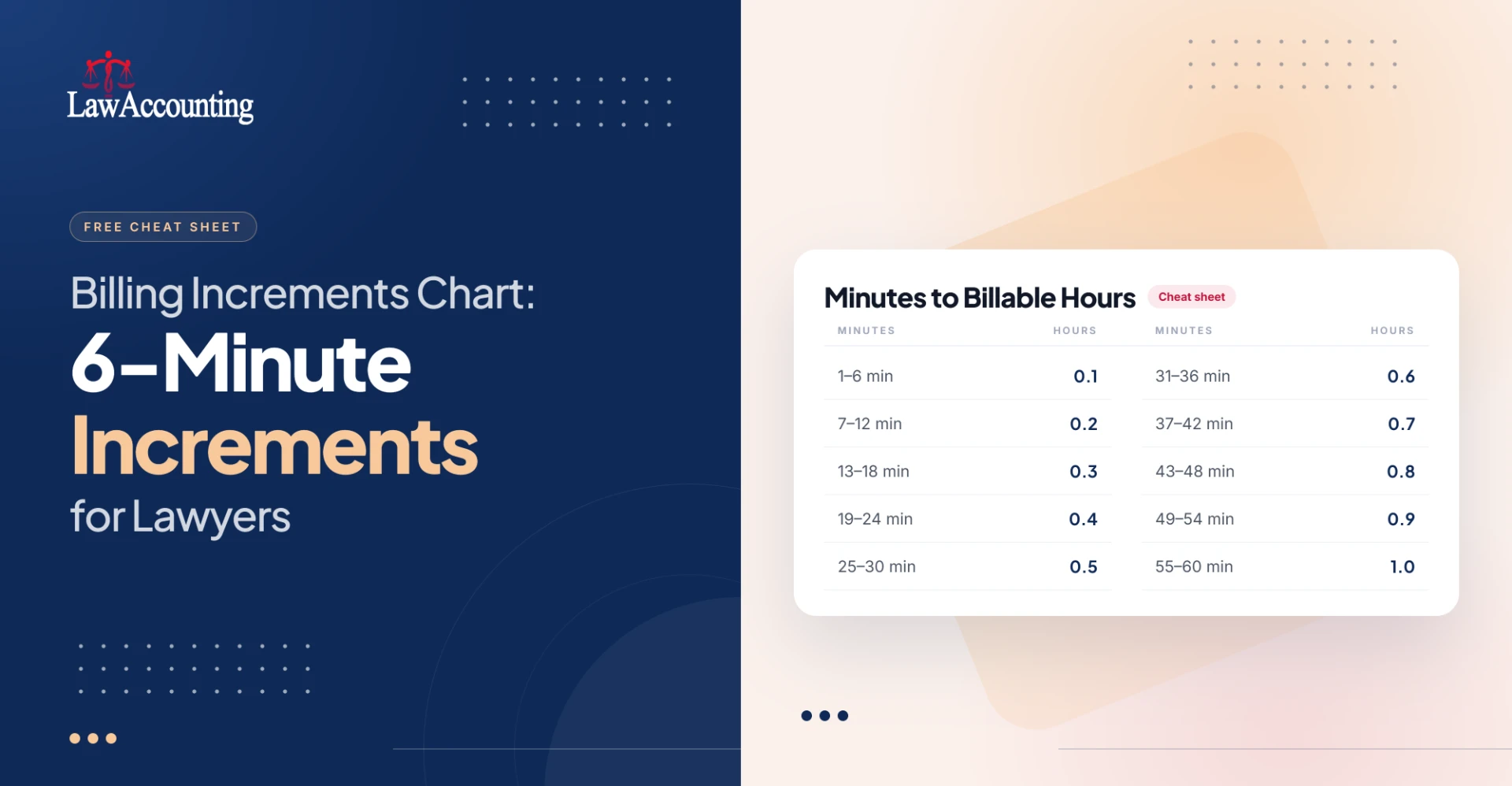
This 6-minute increment chart rounds every entry up to the next tenth, which is how most firms and billing systems handle it. Find the minutes worked in the left column and record the tenths on the right.
| Minutes worked | Billed time (hours) |
|---|---|
| 1 to 6 | 0.1 |
| 7 to 12 | 0.2 |
| 13 to 18 | 0.3 |
| 19 to 24 | 0.4 |
| 25 to 30 | 0.5 |
| 31 to 36 | 0.6 |
| 37 to 42 | 0.7 |
| 43 to 48 | 0.8 |
| 49 to 54 | 0.9 |
| 55 to 60 | 1.0 |
For longer tasks, count the full hours and then look up the leftover minutes. Two hours and 20 minutes becomes 2.4. Our billable hours chart has more worked examples of converting time to tenths.
How to Calculate 6-Minute Increments
To calculate 6-minute increments, divide the minutes worked by 6 and round up to the next whole number. That number is your tenths. For example, 22 minutes divided by 6 is 3.67, which rounds up to 4, so you bill 0.4 hours. At a rate of $300 an hour, that entry comes to $120.
Rounding Up vs Rounding to the Nearest Tenth
The chart above always rounds up, so a 7-minute call is billed as 12 minutes. Some firms round to the nearest tenth instead. The Georgia bar opinion suggests rounding up only when more than half of the next unit was actually spent, which for tenths means more than 3 minutes.
Here's how that method compares, with a 0.1 minimum for any billable task:
| Minutes worked | Always round up | Round up only past the halfway point |
|---|---|---|
| 1 to 3 | 0.1 | 0.1 (minimum) |
| 4 to 6 | 0.1 | 0.1 |
| 7 to 9 | 0.2 | 0.1 |
| 10 to 12 | 0.2 | 0.2 |
| 13 to 15 | 0.3 | 0.2 |
| 16 to 18 | 0.3 | 0.3 |
The difference is small on one entry. Across hundreds of entries a month, it adds up, which is why the method should be written down and used the same way by every timekeeper.
10-Minute and 15-Minute Increment Charts
Firms that bill in larger increments still need a chart, because the decimals are less obvious. Both charts below round up.
10-Minute Increment Chart
| Minutes worked | Billed time (hours) |
|---|---|
| 1 to 10 | 0.17 |
| 11 to 20 | 0.33 |
| 21 to 30 | 0.50 |
| 31 to 40 | 0.67 |
| 41 to 50 | 0.83 |
| 51 to 60 | 1.00 |
One 10-minute unit is one-sixth of an hour, or 0.1667. Most billing systems show it to two decimal places, as above.
15-Minute Increment Chart
| Minutes worked | Billed time (hours) |
|---|---|
| 1 to 15 | 0.25 |
| 16 to 30 | 0.50 |
| 31 to 45 | 0.75 |
| 46 to 60 | 1.00 |
Minutes to Decimal Hours Conversion Chart
To convert minutes to decimal hours, divide the minutes by 60. Use this table when you need the exact decimal rather than a rounded increment, such as for flat fee matters, internal reports, or checking a timer entry.
| Minutes | Hours | Minutes | Hours | Minutes | Hours |
|---|---|---|---|---|---|
| 1 | 0.02 | 21 | 0.35 | 41 | 0.68 |
| 2 | 0.03 | 22 | 0.37 | 42 | 0.70 |
| 3 | 0.05 | 23 | 0.38 | 43 | 0.72 |
| 4 | 0.07 | 24 | 0.40 | 44 | 0.73 |
| 5 | 0.08 | 25 | 0.42 | 45 | 0.75 |
| 6 | 0.10 | 26 | 0.43 | 46 | 0.77 |
| 7 | 0.12 | 27 | 0.45 | 47 | 0.78 |
| 8 | 0.13 | 28 | 0.47 | 48 | 0.80 |
| 9 | 0.15 | 29 | 0.48 | 49 | 0.82 |
| 10 | 0.17 | 30 | 0.50 | 50 | 0.83 |
| 11 | 0.18 | 31 | 0.52 | 51 | 0.85 |
| 12 | 0.20 | 32 | 0.53 | 52 | 0.87 |
| 13 | 0.22 | 33 | 0.55 | 53 | 0.88 |
| 14 | 0.23 | 34 | 0.57 | 54 | 0.90 |
| 15 | 0.25 | 35 | 0.58 | 55 | 0.92 |
| 16 | 0.27 | 36 | 0.60 | 56 | 0.93 |
| 17 | 0.28 | 37 | 0.62 | 57 | 0.95 |
| 18 | 0.30 | 38 | 0.63 | 58 | 0.97 |
| 19 | 0.32 | 39 | 0.65 | 59 | 0.98 |
| 20 | 0.33 | 40 | 0.67 | 60 | 1.00 |
How Much Does Rounding Add to a Bill?
Rounding adds the most on short tasks, and the larger the increment, the bigger the gap. Here's a hypothetical example. An associate billing $300 an hour handles eight quick emails and calls in a day, each on a different matter, and each takes 2 minutes. That's 16 minutes of actual work.
| Billing method | Time billed | Amount billed |
|---|---|---|
| Actual time worked | 16 minutes (0.27 hours) | $80 |
| 6-minute increments, rounded up | 0.8 hours | $240 |
| 15-minute increments, rounded up | 2.0 hours | $600 |
The same 16 minutes of work bills at $240 in tenths and $600 in quarter hours. That gap is why clients look hard at short entries, and why many firms group related short tasks on the same matter into one entry. Four emails to opposing counsel about deposition dates that take 8 minutes in total can go on one entry at 0.2, instead of four entries at 0.1 each.
Is It Ethical to Round Up Billable Time?
Yes, within limits. Rounding up to a standard increment is accepted practice, but using the increment to bill time that wasn't worked is not.
ABA Formal Opinion 93-379 (1993) says a lawyer who agrees to bill by the hour can't bill more time than was actually spent, apart from rounding up to minimum units such as a tenth or a quarter of an hour. The State Bar of Georgia's Formal Advisory Opinion 01-1 goes further. It allows billing in standard units as long as the total fee is reasonable under Rule 1.5(a) and the client is told how billing works. But it says repeatedly rounding a one-minute task up to 15 minutes raises real questions about whether the fee is reasonable.
Courts look at how the increment is used, not just its size. In a 2018 case, the Wyoming Supreme Court upheld a firm's 15-minute minimum billing for a longtime client. As the ABA Journal reported, billing in minimum 15-minute increments wasn't abusive in that case because the firm's lawyers rounded down when a task fell between two intervals, and the billed time included related work such as pulling the file and writing up notes after a call. The court contrasted it with an earlier case where a lawyer billed 15 minutes every time she signed a document.
This section is general information, not legal advice. Check your state's rules and ethics opinions before setting your firm's rounding policy.
Minimum Charges for Emails and Calls
Some firms set a minimum charge for certain tasks, such as 0.2 hours for every email or phone call, no matter how long it takes. Others treat one increment, 0.1, as the minimum.
A minimum that's larger than your normal increment makes short entries look padded, and many corporate and insurance clients won't pay it. If your firm uses a minimum charge, write it into the engagement letter, and only apply it when the entry really includes related work, such as reviewing the file before a call.
Which Billing Increment Should Your Firm Use?
For most firms, 6-minute increments are the right choice. They're the most common, they're what most clients expect, and bar opinions treat them as the safest unit. Larger increments can work for practices where most tasks run long, but they draw more questions from clients and in fee disputes.
Whatever increment you pick, the rules around it matter as much as the number.
Put the Increment in the Engagement Letter
State the increment, the rounding method, and any minimum charges in the engagement letter or fee agreement. The Georgia opinion makes telling the client how billing works a condition of billing in standard units. Our guide to building an engagement letter and fee agreement workflow covers the billing terms that hold up in a fee dispute.
Follow Client Billing Guidelines
Corporate and insurance clients often set the increment and rounding rules in their outside counsel guidelines, usually a tenth of an hour, and their e-billing systems can reject entries that don't match. When a client's rules differ from your firm's default, bill that client's matters by the client's rules.
Use the Same Rule for Every Timekeeper
If one partner rounds up and another rounds to the nearest tenth, clients get different bills for the same work. Put the rule in the firm's billing policy and check for it during pre-bill review.
Record Time as You Go
Rounding rules only work if the minutes behind them are real. Time reconstructed at the end of the week tends to get rounded generously or forgotten entirely. Our guide on how to track billable hours covers how to capture time while the work happens.
Billing Increments Cheat Sheet
Save or print this section for quick reference.
| Increment | One unit in hours | How to calculate | Example: 22 minutes |
|---|---|---|---|
| 6 minutes | 0.1 | Minutes divided by 6, rounded up, times 0.1 | 0.4 |
| 10 minutes | 0.17 | Minutes divided by 10, rounded up, times 0.1667 | 0.5 |
| 15 minutes | 0.25 | Minutes divided by 15, rounded up, times 0.25 | 0.5 |
Common conversions: 0.1 = 6 minutes, 0.25 = 15 minutes, 0.5 = 30 minutes, 0.75 = 45 minutes, 1.0 = 60 minutes.
- Use 0.1 hour as your default increment unless a client's guidelines say otherwise.
- Write the increment, the rounding method, and any minimum charge into the engagement letter.
- Group related short tasks on the same matter into one entry.
- Never use rounding to bill time that wasn't worked.
- Apply the same rule for every timekeeper, and check it during pre-bill review.
Billing Increments in LawAccounting
A rounding policy only works if someone checks the entries before they reach the client. In LawAccounting, rates can be set per client, per matter, or per timekeeper, so a client with its own rate terms is billed correctly. Before an invoice goes out, the responsible attorney reviews the pre-bill and can edit or write off entries, and every bill keeps an approval trail.
For corporate and insurance clients, invoices can be exported as LEDES files with UTBMS task and activity codes applied. Write-offs and billing realization are tracked in reporting, so you can see where short entries are being cut. See the Billing and Invoicing features, or book a demo.
Frequently Asked Questions
How many minutes is 0.1 of an hour?
0.1 of an hour is 6 minutes. Ten of those units make one hour, which is why 6-minute billing is also called billing in tenths.
How do you convert minutes to tenths of an hour?
Divide the minutes by 6 and round up to the next whole number. That number is your tenths. For example, 20 minutes divided by 6 is 3.33, which rounds up to 4, so you bill 0.4 hours.
Do lawyers have to bill in 6-minute increments?
No rule requires a specific increment. Firms choose their own, but the resulting fees must be reasonable, and the client should know how time is billed. Some corporate and insurance clients require 0.1-hour increments in their billing guidelines.
How many minutes is 0.25 hours?
0.25 hours is 15 minutes. In the same way, 0.5 hours is 30 minutes and 0.75 hours is 45 minutes.
Can a lawyer bill 0.1 for reading a short email?
Many firms bill one increment, 0.1 hour, as the minimum for any billable task, and ethics opinions generally accept rounding up to a minimum unit. But a long run of 0.1 entries for one-line emails draws client scrutiny. Grouping related emails on the same matter into one entry is usually the better approach.
Should billing increments be in the engagement letter?
Yes. The engagement letter should state the increment, how time is rounded, and any minimum charges. Telling the client how billing works up front heads off disputes later, and some bar opinions treat it as a condition of billing in standard units.
What is the difference between a billable hour and a billing increment?
A billable hour is the unit your hourly rate applies to. A billing increment is the fraction of that hour used to record each task, such as a tenth or a quarter. A lawyer at $300 an hour who bills 0.3 for a task charges $90.