
Legal Accounting September 25, 2026 6 min read
Debunking AI Myths About Law Firm Accounting
Six common AI myths about law firm accounting, trust accounting, confidentiality, billing, firm size, and responsibility — and what the rules actually require.
Written by LawAccounting Editorial Team, Legal Technology · Trust Accounting · Practice Management · Legal Technology Editors
Most of what gets written about AI in law firms is about drafting, research, and whether lawyers will still have jobs in ten years. Very little of it is about the books.
The books are where the bar actually disciplines people. In California, a trust account compliance review that turns up serious findings can be escalated to an investigative audit or referred to the Office of Chief Trial Counsel.
So when a firm sits through a software demo and hears the word AI, the accounting questions tend to go unasked. What touches the ledger. Where client data goes. Who signs off. Whether the fee is still defensible afterward. Below are six AI myths about law firm accounting that come up in those conversations, and what the rules and the record actually say.
Myth 1: AI in accounting software means AI is moving your money
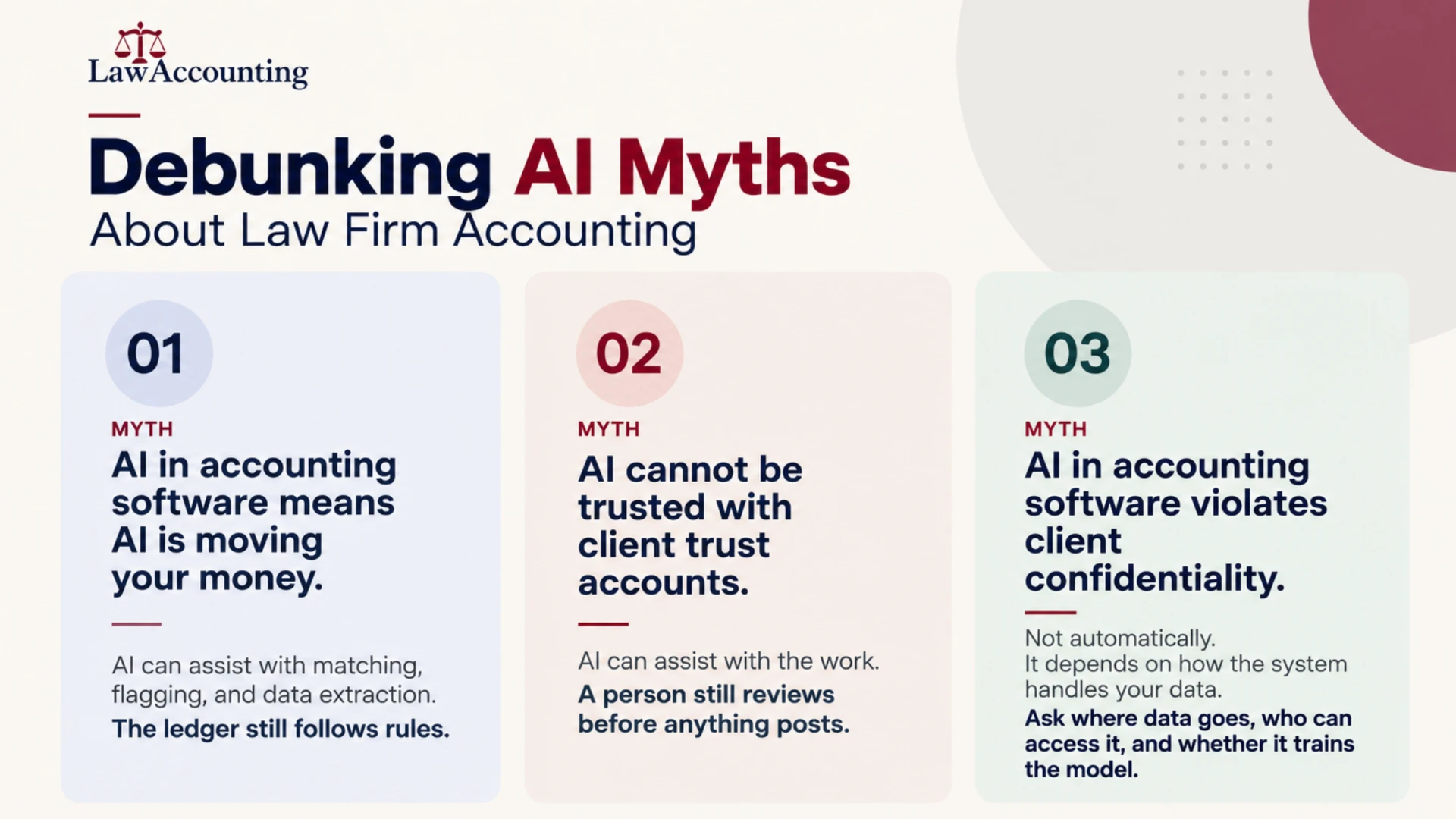
AI covers a wide range of things. AI in legal accounting usually describes a narrow set of jobs: reading a bank statement and suggesting which matter a deposit belongs to, flagging a time entry that looks out of pattern, pulling line items off a vendor invoice, drafting a prebill narrative from the underlying entries.
None of that is the ledger. The ledger is arithmetic and rules. A per-matter balance either goes negative or it does not. A three-way reconciliation either ties or it does not. Those checks are deterministic, and they run the same way whether or not the system has AI anywhere in it.
A better question for a vendor: which specific actions can the AI take on its own, and which ones need a person to approve them. A good answer is a short, boring list.
Myth 2: AI cannot be trusted with client trust accounts
This one deserves care, because AI trust accounting is the highest-consequence part of the conversation.
Before launching mandatory compliance reviews, the State Bar of California ran a voluntary pilot. Over 300 firms applied, 21 were selected, and 18 finished. Fifteen had noncompliant trust account journals. Sixteen had noncompliant client ledgers. Fifteen had noncompliant monthly three-way reconciliations.
Small sample, and the firms volunteered, so read it for what it is. But those failures happened without AI anywhere near them. They were recordkeeping failures: ledgers not kept per client, reconciliations not performed monthly, records not supporting the transactions they were meant to support.
AI did not cause that, and AI by itself does not fix it. What fixes it is a system that keeps a running per-matter balance, blocks a disbursement that would overdraw one client's funds even when the overall bank balance covers it, and produces the three-way reconciliation on a schedule instead of on request. AI helps with the work in front of that, matching an incoming wire to the right matter or surfacing a ledger that has not moved in ninety days. A person still confirms it before it posts.
Myth 3: AI in accounting software violates client confidentiality
Not automatically. But the worry behind the myth is legitimate, and the answer depends entirely on the product.
ABA Formal Opinion 512, issued in July 2024, works through this under Model Rule 1.6. Its concern is specific. Some tools are self-learning, meaning what you put in can become part of what the tool learns from and may surface somewhere else. That is a different risk from a tool that processes your data and keeps it inside your own environment.
Four narrower things decide it: whether client data leaves your tenant, whether it trains anything, who at the vendor can read it, and how long it is retained. All four are answerable in writing, and you should ask for them in writing before you sign.
Myth 4: Billing with AI makes your fees harder to defend
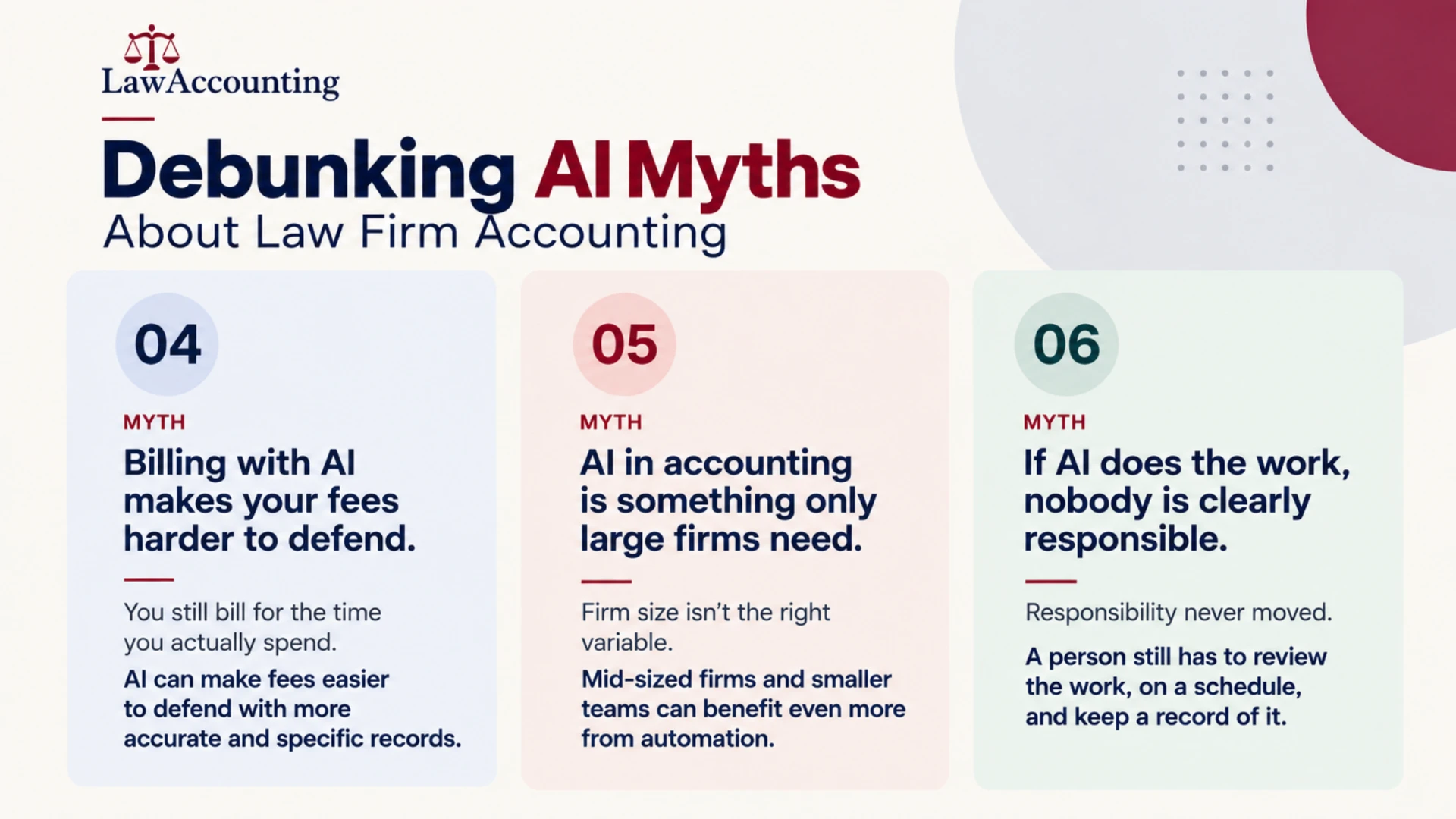
Opinion 512 also addresses fees, under Model Rule 1.5, and the rule it lands on is plain. You bill for the time you spent. If a task that used to take three hours now takes twenty minutes, twenty minutes is what goes on the invoice.
Firms sometimes read that as a reason to keep AI out of billing, on the theory that the efficiency comes straight out of revenue. That is a pricing decision rather than an ethics problem, and flat fees have existed for a long time.
The narrower point about AI legal billing is that it usually makes fees easier to defend. Contemporaneous time capture beats time reconstructed on a Friday afternoon. A prebill review that catches a block-billed entry, or a narrative that reads "attention to file," catches the entries clients challenge before the invoice goes out. The record gets more specific, and specific records are what survive a fee dispute.
Myth 5: AI in accounting is something only large firms need
Firm size is the wrong variable, and getting it wrong distorts a lot of thinking about law firm AI adoption.
An AmLaw firm has a finance department. One person owns trust, another owns billing, another owns the close, and the duties are separated on purpose. A 40-attorney firm has a controller and maybe two people in accounting, carrying the same obligations. That controller owns trust reconciliation alongside billing, collections, payroll, vendor payments, and month-end close.
Records slip in the middle, and not because anyone is careless. Reconciliation has no client attached to it and no deadline until the bar supplies one, so it loses to the work that does.
California assigns each trust account a designated licensee, a single named attorney answerable for it. At most mid-sized firms that name belongs to a managing partner who is not the person doing the reconciling. Automating the matching, the flagging, and the reconciliation prep is worth more to a two-person accounting team than to a department of fifteen.
Myth 6: If AI does the work, nobody is clearly responsible
Responsibility never moved.
Opinion 512 covers supervision under Model Rules 5.1 and 5.3, and the framing is familiar to anyone who has managed people. The duty to supervise applies to the work product regardless of what produced it. A partner who does not review an associate's reconciliation is answerable for what is in it. The same holds for output from software.
This is the part firms skip. Someone has to own the review step, on a schedule, with a record that the review happened. If the system suggests a matter code and nobody checks it, the firm has automated its error rate rather than reduced it.
What to ask when you are evaluating software
AI changes very little about what the rules require of a firm's books, and quite a lot about how much effort it takes to meet them.
The rules have not moved. Safekeeping rules still require records kept per client, and states like California still require a monthly three-way reconciliation on top of that. Model Rule 1.6 still governs where client information goes. Model Rule 1.5 still limits what you can bill. Model Rules 5.1 and 5.3 still put a person's name on the review.
What changes is the work sitting in front of those rules. Matching deposits to matters, pulling data off invoices, catching a ledger that has drifted, assembling the reconciliation package. That work is repetitive, it is the first thing to get postponed when the week gets busy, and postponing it is how most trust account findings begin.
Most legal AI myths lose their force once you have a specific answer in writing. If you are evaluating accounting software this year, ask each vendor to write down three things: which actions the AI can take unattended, where client data goes, and who at their company can read it. Compare the answers.