Legal Technology October 20, 2026 8 min read
Family Law AI: Tools & Use Cases for Attorneys
Published: October 20, 2026
Written by Ramit Kaur · Head of Marketing, LawAccounting
Family law runs on paperwork. One divorce can bring years of bank statements, pay stubs, tax returns, text messages and parenting schedules, and much of that has to be read, sorted and summarized before anyone can give advice. That reading and sorting is where AI helps most in a family law practice.
This guide covers how family law attorneys are using AI today. It walks through the use cases that save the most time, the types of tools to look at, and the ethics rules that apply. There's also a short FAQ at the end.
What is family law AI?
Family law AI is software that uses artificial intelligence to help with the work in divorce, custody, support and related matters. That work includes reading documents, drafting, research, intake and client communication.
Most of these tools are built on large language models, the same technology behind general chatbots. The difference is how they're set up. Legal AI tools are trained or configured for legal work and usually come with stricter data protections. General chatbots are not designed for confidential client information.
AI doesn't make decisions in a case. It produces drafts, summaries and suggestions. An attorney still has to review all of it.
How are family law attorneys using AI?
Family law attorneys mostly use AI to cut down the time spent reading, sorting and drafting. These are the use cases where it makes the biggest difference.
Reviewing financial disclosures and bank statements
In a contested divorce, someone has to go through months or years of bank and credit card statements. AI can sort transactions into categories, total spending by category, and flag large transfers, cash withdrawals or payments to unfamiliar accounts. That gives the attorney a starting point for questions about hidden assets or dissipation.
The AI's work is a first pass. Every flagged item still needs to be checked against the source document before it goes into a filing or a settlement position.
Drafting pleadings, letters and parenting plans
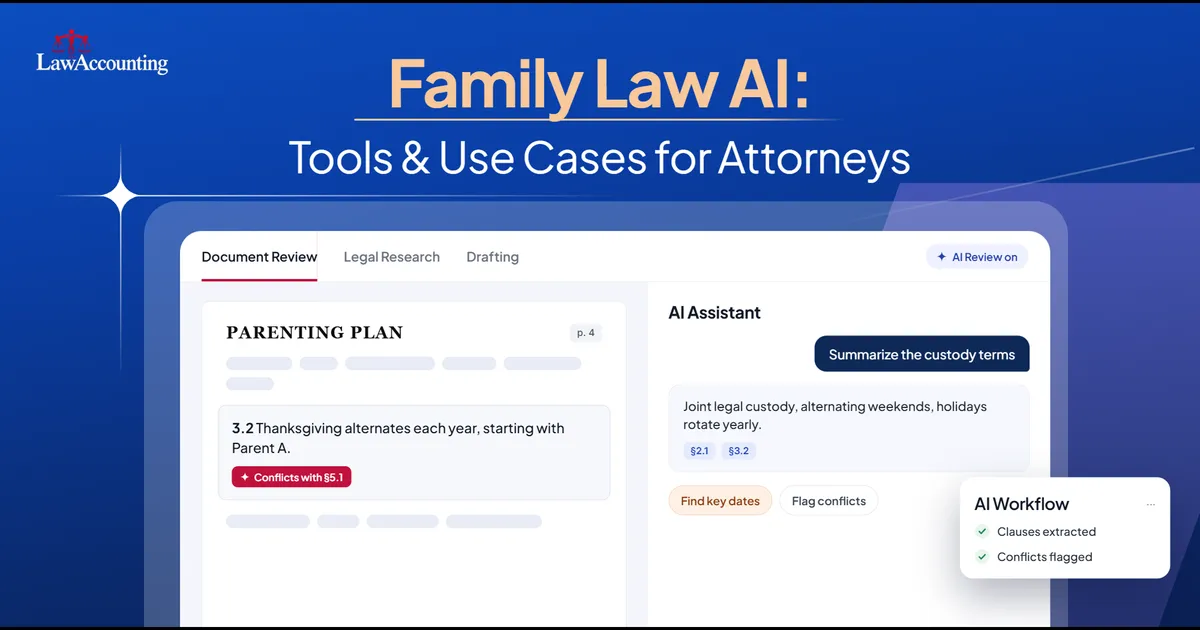
AI can produce first drafts of routine documents: petitions, discovery requests, client letters, settlement proposals and parenting plan schedules. You give it the facts and your template, and it gives you a draft to edit.
This works best when the firm feeds it its own approved templates. Your court's forms and local rules still decide the final format.
Summarizing communications for custody matters
Custody cases often involve hundreds of texts, emails or messages from co-parenting apps. AI can summarize these by date or topic and pull out the messages that matter, such as missed pickups, schedule changes or concerning language. The attorney then reads the actual messages before relying on them.
Gathering inputs for child support calculations
Child support is set by your state's guidelines, and the math should be done in the official state calculator or a tool built on it. AI can help collect what goes into that calculation, like income figures from pay stubs and tax returns, childcare costs and health insurance premiums. Don't rely on a general AI tool to do the calculation itself.
Client intake
Family law clients often reach out after hours and under stress. AI intake tools can answer basic questions, collect contact details and case facts, check for conflicts and book consultations. A person at the firm should still follow up quickly, and the tool should never give legal advice.
Legal research
Legal AI research tools can find relevant cases and statutes and summarize them. Check every citation against the primary source. AI tools have produced fake or wrong case citations, and courts have sanctioned lawyers who filed them.
Billing, time entries and retainers
Family law firms usually work from retainers, and matters can go on for months. AI can help draft time entry descriptions and point out unbilled work, but the billing data underneath has to be correct. Retainer deposits go into trust, earned fees move to operating, and clients need clear invoices. AI makes this faster only when billing, trust and accounting records match.
What are the best AI tools for family law attorneys?
There isn't one best AI tool for family law. Most firms use a few, each for a different job. The main categories are:
- Legal research tools that search case law and statutes and summarize results
- Document drafting and automation tools that build first drafts from your templates
- Document review tools that read and summarize large sets of records, like financial disclosures
- Intake and answering tools that respond to new inquiries and book consultations
- Transcription tools that record and summarize client meetings, with the client's consent
- Practice management, billing and accounting software with AI features for time entries, billing and reporting
Start with the job that takes your team the most hours. For many family law firms, that's financial document review or intake.
How to choose an AI tool for a family law firm
Before you sign up for any AI tool, get clear answers to these questions:
- Does the vendor train its models on your data? The answer should be no, and it should be written in the contract.
- Where is the data stored, and for how long? You should be able to delete client data when a matter closes.
- What security certifications does the vendor have? Look for an independent audit such as SOC 2.
- Does it work with the systems you already use? A tool that needs data copied in by hand adds a step instead of saving one.
- Can you check where an answer came from? Research and review tools should point to the source document or case.
Run a small test on a closed matter before you use the tool on live client work.
Is it ethical for family lawyers to use AI?
Yes, as long as you follow your existing professional duties. In July 2024, the ABA issued Formal Opinion 512, its first formal guidance on lawyers using generative AI. It doesn't create new rules. It explains how the current Model Rules apply.
The main points:
- Competence (Rule 1.1): You need a reasonable understanding of what the tool can and can't do, and you must review its output.
- Confidentiality (Rule 1.6): Before you put client information into a tool that could share or learn from it, you need the client's informed consent.
- Communication (Rule 1.4): In some situations you should tell clients you're using AI, especially if it affects their case or their bill.
- Fees (Rule 1.5): You can bill for the time you actually spend, but not for time AI saved you. You generally can't charge clients for time spent learning a tool.
- Supervision (Rules 5.1 and 5.3): Firms need policies so that associates and staff use AI correctly.
Many state bars have issued their own AI guidance, so check your state's rules too. Family law adds extra care. These matters often involve children, abuse allegations and private financial records, so be strict about what goes into any AI tool.
What AI can't do in family law
AI can't sit with a client going through a divorce, read a judge or negotiate with opposing counsel. It doesn't know which issue matters most to your client or when to settle. It also can't take responsibility for a filing. The attorney who signs it does. Use AI for the reading, sorting and first drafts, and keep the judgment calls with the lawyer.
Frequently asked questions about family law AI
What is family law AI?
It's AI software that helps family law attorneys with document review, drafting, research, intake and billing in divorce, custody and support matters.
How are family law attorneys using AI today?
Mostly to review financial disclosures, draft routine documents, summarize client communications, handle intake and speed up research.
What are the best AI tools for family law attorneys?
There's no single best tool. Firms usually combine legal research, drafting, document review, intake and practice management tools, and choose based on where they lose the most time.
Can AI review financial disclosures in a divorce case?
Yes. AI can sort transactions and flag unusual activity in bank and credit card statements. An attorney or financial professional should check the findings against the original records.
Is it ethical for family lawyers to use AI?
Yes, if you meet your duties of competence, confidentiality, communication, reasonable fees and supervision. ABA Formal Opinion 512 explains how these apply.
Is client data safe in AI tools?
It depends on the tool. Use vendors that don't train on your data, that have independent security audits, and that let you delete data. Don't put confidential client information into free consumer chatbots.
Can a family law firm bill clients for time spent using AI?
You can bill for the actual time spent working, including reviewing AI output. You can't bill for hours the AI saved, and you generally can't bill for learning the tool.
Will AI replace family lawyers?
No. AI handles reading and drafting. Advising clients, negotiating and appearing in court still require a lawyer.
How should a family law firm choose an AI tool?
Check how the vendor handles data, its security audits, whether it works with your existing systems, and whether you can trace its answers to sources. Test it on a closed matter first.
Where to start with AI in your family law practice
The firms getting the most from AI started small. They picked one task that ate up hours every week, tested a tool on it, and set clear rules about what client data goes in. Financial disclosure review and intake are good places to begin.
AI also works better when the data underneath it is in order. If your billing, trust and accounting records are spread across separate systems, AI only speeds up the mess. LawAccounting keeps billing, trust accounting and the general ledger in one platform, which gives your firm a cleaner base to build on.