
Legal Billing September 23, 2026 9 min read
Lawyer Hourly Rates: How to Set Them, Raise Them, and Actually Collect Them
Learn how to set lawyer hourly rates, calculate your firm's pricing floor, improve realization, raise rates, and decide when flat fees make more sense.
Written by LawAccounting Editorial Team, Legal Technology · Trust Accounting · Practice Management · Legal Technology Editors
Most articles about the lawyer hourly rate stop at what other firms charge. That number is the easiest one to find and the least useful one you have.
The rate you publish, the rate you bill, and the rate you collect are three different numbers. Firms that manage the gap between them do better than firms that spend the year arguing about the first one.
What is a lawyer hourly rate, and what do firms actually charge?
An hourly rate is the price a firm charges for one hour of a timekeeper''s work on a client matter. Firms set different rates by seniority, so a partner, an associate and a paralegal each carry their own. The blended rate is the weighted average across everyone who touched the file, and it is usually the number that matters to a client and to your own profitability analysis.
On what firms charge, Clio''s Legal Trends Report puts the 2025 US average lawyer rate at $349, with non-lawyer timekeepers at $187 and a blended law firm rate of $311. State variation is wide. California sits around $420 and Ohio around $276, and the practice area moves it further in both directions.
Use those as orientation, not as a target. A national average tells you very little about what your specific clients in your specific market will pay for your specific work.
How to calculate an hourly rate that actually covers the firm
The arithmetic is simple and most firms skip it anyway.
Start with your total annual cost to operate. Salaries, benefits, rent, insurance, technology, malpractice coverage, and partner compensation if you are treating that as a cost rather than as profit. Then add the profit margin you want.
Divide that by realistic billable hours, and realistic is the word doing the work. Not the target. What your timekeepers actually billed last year, taken from your own data. If your target is 1,800 and your attorneys average 1,550, using 1,800 in this calculation sets a rate that cannot cover the firm.
That gives you a floor. The market gives you a ceiling. Your rate lives between them, and if the floor is above the ceiling, the problem is cost structure or utilization, not pricing.
Why the rate you set is not the rate you collect
Here is the finding worth sitting with. The Thomson Reuters Institute''s Law Firm Rates Report 2026, based on reported results from 195 US firms, found that firms have sorted themselves into three different operating models depending on how aggressively they set rates and how much discounting and write-down they accept. Despite those very different strategies, firms generally collect about the same amount per hour.
The same report notes that worked rates rose 7.4% in 2025 against 2.8% inflation, and that over the past decade firms have pushed rates at twice the rate of inflation or more.
Put those together and the implication is uncomfortable. Raising your rate does not reliably raise what you collect. Market forces pull firms toward a similar outcome regardless of the strategy on paper.
What separates firms is realization, the share of billed value that turns into money in the bank. The usual formula is net revenue divided by the value of billable work, times 100.
Worked through: an attorney bills 100 hours at $500, creating $50,000 of value. Prebill review knocks off ten hours, so the invoice goes out at $45,000. The client disputes a line and pays $40,500. The standard rate never changed. The firm collected 81% of it.
A word of caution on benchmarks here. Published realization averages vary widely depending on who is publishing them and how they define the numerator, so treat any single industry figure carefully and measure your own instead. Your own number, tracked monthly, is worth more than anyone else''s average.
How much should a firm raise its rates, and what do the rules require?
Two separate questions, and firms usually only think about the first.
On the amount, look at your realization before you look at the market. If you are collecting 80% of standard, a rate increase widens the gap between what you bill and what you get, and it gives clients a fresh reason to scrutinise invoices. Fix the leak, then raise the rate.
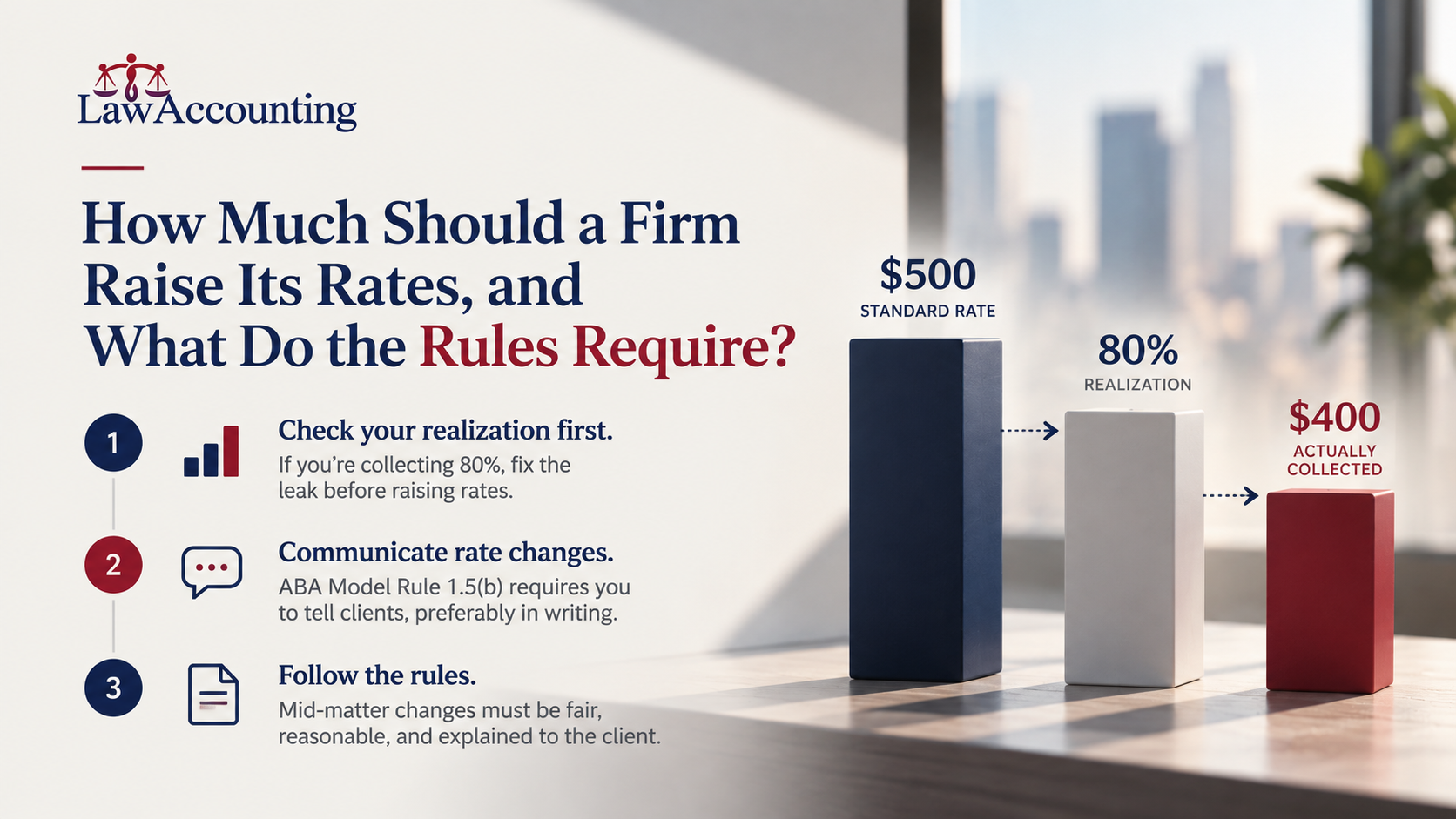
According to the rules, ABA Model Rule 1.5(b) requires that the basis or rate of the fee be communicated to the client, preferably in writing, before or within a reasonable time after the representation starts. It also requires that any change to the basis or rate be communicated.
ABA Formal Opinion 11-458, issued in August 2011, goes further on mid-representation changes. A lawyer acting as a fiduciary carries a particular burden to justify changing a fee agreement midstream. The change has to be fair and reasonable given changed circumstances, judged as at the time of the modification. It has to be explained to the client, not merely announced. And the opinion treats periodic rate increases as generally acceptable where the practice was clearly communicated and accepted at the start of the relationship and the increases themselves are reasonable.
The practical reading for a firm administrator sending rate letters in December: a clause in your engagement letter saying the firm may raise rates from time to time helps, but it is not a substitute for telling a client the specific new rate before you bill it. Some states, Colorado among them, require the communication in writing. Check your own rule rather than the model.
When flat fees make more sense than hourly
Hourly works when scope is genuinely unpredictable. It works badly when the work is repeatable and the client knows roughly what it should cost.
Flat fees suit matters where you have enough history to price them: uncontested divorces, straightforward bankruptcy filings, standard immigration petitions, trademark applications, simple wills. If you have run two hundred of something, you know what it costs you, and the client would rather buy certainty.
The billing question is separate from the tracking question. Firms moving to flat fees sometimes stop capturing time, which is a mistake. Without time data you cannot tell whether a flat fee is profitable, and you will discover the answer only when the practice area stops making money.
What to fix before you touch the rate
Rate is the last lever, not the first. Before you change it, look at where the billed value disappears between the work and the payment.
Time captured days after the fact, which is both less accurate and less defensible. Prebill write-downs, and whether the same narratives cause them every month. How long the invoice sits between period close and going out. How long it sits with the client after that. The administrative work sitting between a billable hour and a collected dollar is usually a bigger number than the increase you were planning.
A firm collecting 95% of a $400 rate is ahead of a firm collecting 80% of $450.
Frequently asked questions
What is the average lawyer hourly rate?
Clio''s Legal Trends Report puts the 2025 US average at $349 per hour for lawyers, $187 for non-lawyer timekeepers, and $311 as a blended law firm rate. State averages range from roughly $250 to over $420, and practice area widens the spread further. Treat the national figure as context rather than a benchmark to match.
How do you calculate a lawyer''s hourly rate?
Add your firm''s total annual operating cost to your target profit, then divide by the billable hours your timekeepers realistically produce, based on last year''s actual numbers rather than your target. That sets a floor. Compare it against market rates for your practice area and location to find the ceiling. If the floor exceeds the ceiling, the issue is cost or utilization rather than price.
How much should a law firm raise its rates each year?
There is no single correct figure, and the right one depends on your realization more than on the market. Thomson Reuters reports worked rates rising 7.4% in 2025 against 2.8% inflation, so increases well above inflation have been normal. If your collections are already lagging your standard rate, a larger increase tends to widen that gap rather than close it.
Do you need a client''s consent to raise your hourly rate mid-matter?
Model Rule 1.5(b) requires communicating any change in the basis or rate of the fee. ABA Formal Opinion 11-458 treats a midstream change as something the lawyer must justify as fair and reasonable at the time it is made, and explain to the client rather than simply notify. Periodic increases are generally acceptable where the practice was communicated and accepted at the outset. A general clause reserving the right to raise rates helps, but it does not replace telling the client the specific new rate beforehand. State rules vary, and some require communication in writing.
What is a good realization rate for a law firm?
Realization measures the share of billed value that gets collected, calculated as net revenue divided by the value of billable work. Published industry averages differ significantly depending on the source and the definition used, so the more useful practice is tracking your own figure monthly and watching the direction rather than comparing against a benchmark you cannot verify.
When does flat fee billing make more sense than hourly?
When scope is predictable and you have enough matter history to price it accurately. Routine filings and standardized documents fit well. Litigation and anything with unpredictable scope generally does not. Keep capturing time either way, because without it you cannot tell whether a flat fee is profitable.
The Bottom Line
Setting lawyer hourly rates is a financial exercise, not a market-matching exercise. Know your floor, watch your realization monthly, communicate every change the way the rules require, and fix the administrative leaks before you reach for the rate.