Trust Accounting November 17, 2026 12 min read
Legal Retainer Agreement Template (Free Sample for Law Firms)
Last updated: November 2026
Written by Ramit Kaur · Head of Marketing, LawAccounting
A legal retainer agreement is a written contract between a law firm and a client that sets out the work the firm will do, how fees are charged, how much the client pays up front, and how that money is held and applied. The free retainer agreement template below is written for law firms and covers the clauses that most often cause disputes: the retainer deposit, when fees are earned, replenishment, and refunds.
Most templates online are built for freelancers or for clients hiring a lawyer. This one is built for the firm, including the accounting and trust rules your billing team has to follow once the agreement is signed.
What Is a Legal Retainer Agreement?
A legal retainer agreement, sometimes called an attorney retainer agreement or fee agreement, defines the relationship between a law firm and its client. It states who the client is, what the firm will and won't do, the fee arrangement, the retainer amount, how invoices are paid, and how either side can end the relationship.
The retainer itself is the upfront payment. The agreement is the document that explains what that payment is for and what happens to it. For a full explanation of retainer fees and how they're calculated, see our guide on what a retainer fee is.
Retainer Agreement vs Engagement Letter
A retainer agreement and an engagement letter do the same job, and many firms use the terms interchangeably. The practical difference is form:
- An engagement letter is usually written as a letter from the firm to the client, describing the scope, fees, and terms, which the client signs to accept.
- A retainer agreement is usually written as a formal contract with numbered clauses, signed by both sides.
Some states treat them as equivalent for compliance purposes. New York, for example, lets a lawyer meet its written engagement requirement with either a letter of engagement or a signed retainer agreement, as long as it covers the required topics. Whichever format you use, what matters is that it covers scope, fees, expenses, and billing practices clearly.
Is a Written Retainer Agreement Required?
Not always, but it's strongly recommended, and in many situations it's required. Under ABA Model Rule 1.5, the scope of the representation and the basis or rate of the fee must be communicated to the client, preferably in writing, before or soon after the representation starts. A contingent fee agreement must be in writing and signed by the client.
Many states go further:
- California requires a written fee agreement when the client's total expense, including fees, is expected to exceed $1,000, with some exceptions.
- New York requires a written letter of engagement or retainer agreement in most matters, with exceptions such as matters where the fee is expected to be under $3,000.
- Tennessee requires any fee that is nonrefundable in whole or in part to be agreed to in a writing signed by the client.
- Arizona doesn't allow a fee to be described as "earned upon receipt" or "nonrefundable" unless the client is told in writing that they can still discharge the lawyer and may be entitled to a refund.
Check your state's version of Rule 1.5 and any related statutes before finalizing your template.
What Should a Legal Retainer Agreement Include?
A complete legal retainer agreement should include:
- Who the client is, and in some matters, who the firm does not represent
- Scope of representation, including what is excluded
- Responsible attorney and staffing
- Fee arrangement, with hourly rates by timekeeper or the flat or contingent fee terms
- Retainer amount and the type of retainer
- Where the retainer is held and when it becomes earned
- How the retainer is applied to invoices
- Replenishment terms, if the retainer must be topped up
- Costs and expenses, and who pays them
- Billing and payment terms
- Refund of unused funds when the matter ends
- Fee dispute process, including any required notice of arbitration rights
- Client responsibilities
- Termination and withdrawal
- File retention
- No guarantee of outcome
- Signatures and date
The template below covers each of these.
Types of Retainers in a Retainer Agreement
Your agreement should name the type of retainer, since each one is handled differently.
Security Retainer (Advance Fee Deposit)
The most common type. The client pays money in advance, the firm holds it in trust, and fees are paid from it as they're earned and billed. Any unused balance is refunded when the matter ends.
General Retainer (Availability Fee)
A payment to secure the lawyer's availability, separate from fees for actual work. Many states allow it only in limited situations and require it to be explained in writing. It's far less common than a security retainer, and firms should treat it with care.
Evergreen Retainer
A security retainer the client must top back up to a set minimum whenever the balance drops below a threshold. It's common in family law and ongoing litigation. Our guide on how to manage evergreen retainers covers replenishment and trust compliance in detail.
Legal Retainer Agreement Template
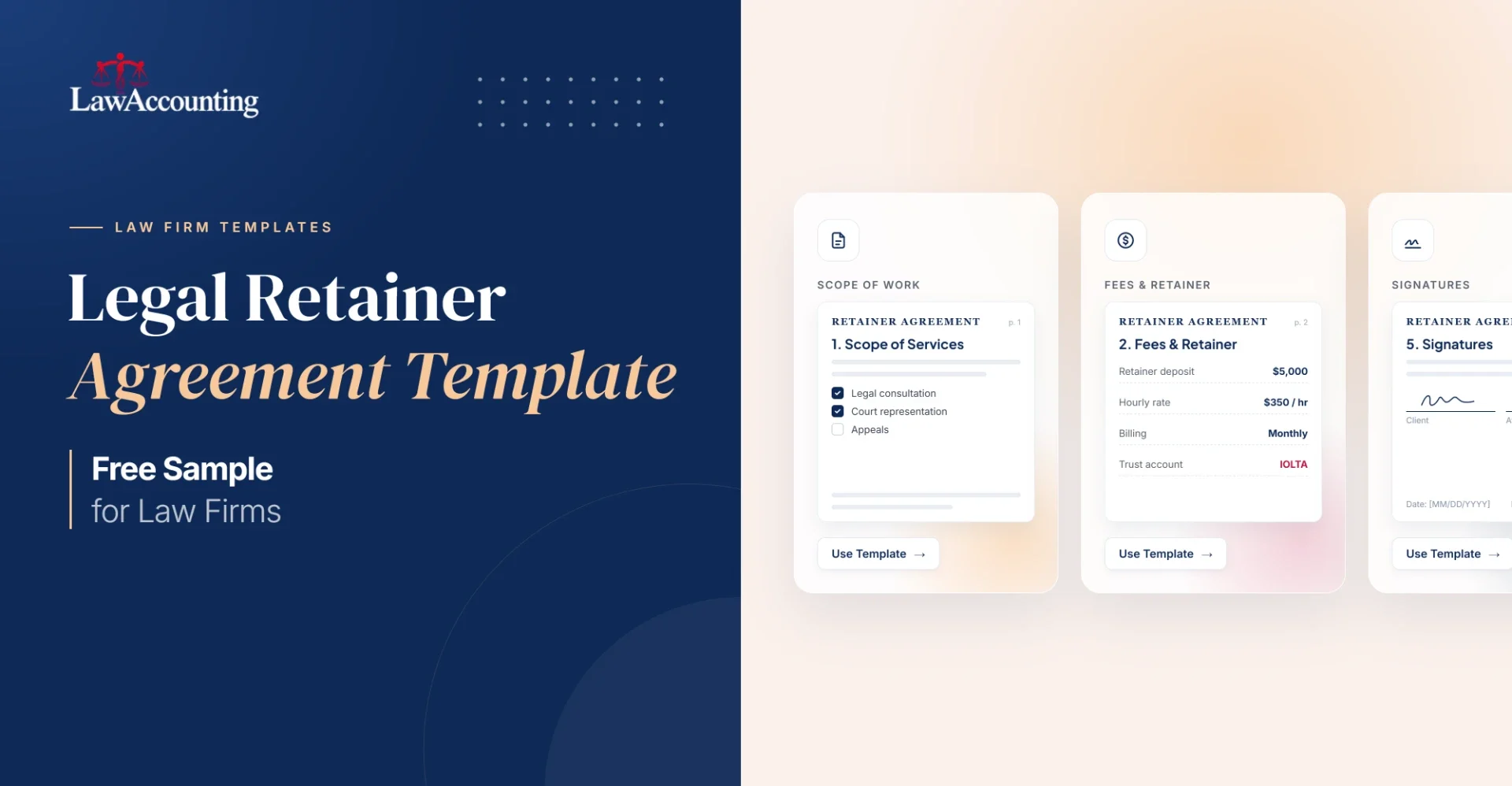
Adapt this template to your firm, your practice area, and your state's rules, and have an attorney at your firm review it before use. Replace everything in brackets.
How to Handle Retainer Funds Under the Agreement
Signing the agreement is the easy part. Handling the money correctly afterward is where most problems start.
Where Should a Law Firm Deposit a Retainer?
An advance retainer goes into the firm's client trust account, usually an IOLTA account, not the operating account. It stays client money until it's earned. Each state sets its own IOLTA rules, and our guide to IOLTA rules by state covers the requirements in all 50 states.
When Is a Retainer Considered Earned?
A retainer is earned when the firm has done the work and billed it as the agreement describes. Under the ABA Model Rules, fees paid in advance stay in trust and are withdrawn only as they're earned. That's why the template ties withdrawals to invoices and gives the client a set number of days to object before funds move to operating.
What Happens to Unused Retainer Funds?
Unused funds belong to the client and must be returned when the representation ends. The commentary to ABA Model Rule 1.5 makes clear that a lawyer may require advance payment of a fee but must return any unearned portion. Send a final invoice, move only the earned amount, and refund the rest promptly.
How a Retainer Replenishment Clause Works
A replenishment clause sets a minimum balance and a target balance. When billed fees bring the trust balance below the minimum, the client deposits enough to bring it back to the target. Set clear dollar amounts and a deadline, and say what happens if the client doesn't replenish, such as pausing non-urgent work.
Are Nonrefundable Retainers Allowed?
Sometimes, but with limits. Every fee must be reasonable, and many states restrict or closely regulate fees labeled "nonrefundable." Some, like Tennessee and Arizona, require specific written terms. Even where a nonrefundable fee is allowed, a client who discharges the lawyer early may still be entitled to a partial refund if the fee wasn't fully earned. If you use one, put the terms in writing, explain them plainly, and check your state's rule first.
Common Retainer Agreement Mistakes
- Calling a deposit "nonrefundable" when it's really an advance against hourly fees
- Putting advance retainers in the operating account instead of trust
- Moving money from trust before the work is billed
- Leaving the scope vague, so the client expects work you didn't price in
- Not updating the agreement when the scope or fee changes significantly
- Leaving out replenishment terms on long matters
- Forgetting the fee arbitration notice in states that require it
Managing Retainers in LawAccounting
Once a retainer agreement is signed, your firm has to track every dollar of that deposit until it's earned or refunded. LawAccounting keeps a separate trust ledger for each matter, moves earned fees from trust to operating based on billed invoices, and flags overdrafts and negative balances before they become compliance problems. The client's retainer balance, invoices, and payments sit on one screen, so your billing team can see when a replenishment request is due.
Frequently Asked Questions
How much should a law firm ask for as a retainer?
There's no standard amount. Many firms base it on the expected fees for the first stage of the matter, such as the first one to three months of work, plus expected costs. Complex or fast-moving matters usually call for a larger retainer.
Can a retainer agreement be signed electronically?
Yes, in most cases. Electronic signatures are generally valid for contracts in the US, and many firms send retainer agreements for e-signature to speed up client intake. Include a clause confirming that electronic signatures are accepted.
Can you change a retainer agreement after the matter starts?
Yes, but changes to the fee or scope should be communicated to the client, and significant changes should be put in writing and signed. Courts may look closely at fee changes made after the attorney-client relationship begins, so explain the reason clearly.
Who should sign a legal retainer agreement?
The client and a representative of the firm, usually the responsible attorney. If the client is a company, the person signing should have authority to bind it. If someone other than the client is paying, the agreement should explain that the firm still represents only the client.
Does a contingency fee agreement have to be in writing?
Yes. Under ABA Model Rule 1.5(c), a contingent fee agreement must be in writing, signed by the client, and must explain how the fee is calculated, including the percentages at each stage and how costs are handled.