Trust Accounting October 7, 2026 8 min read
What Is Three-Way Reconciliation for a Law Firm Trust Account?
Last updated: October 2026
Written by Ramit Kaur · Head of Marketing, LawAccounting
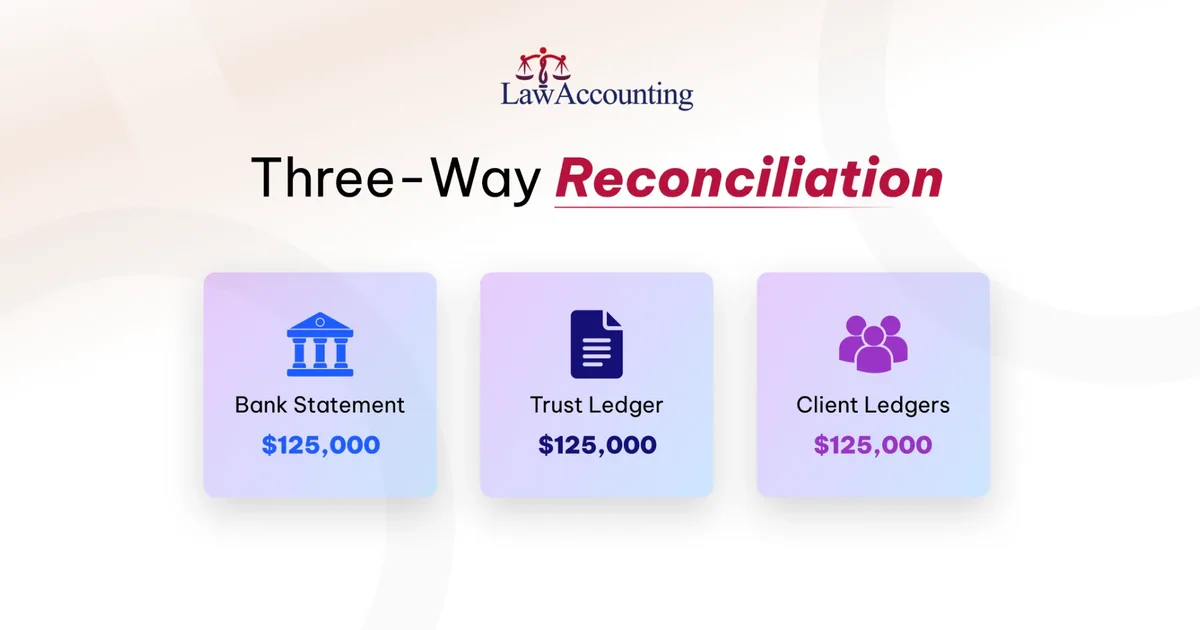
Three-way reconciliation for a law firm trust account is a regular check that three records show the same balance: the bank statement, the firm's trust ledger, and the total of every client's ledger. If all three agree, every dollar in the trust account is accounted for and assigned to the right client. If they don't, something has been recorded wrong, and you need to find it.
This guide is for the accounting managers, controllers, and firm administrators who run the reconciliation at a law firm. It covers the three parts, how often to do it, a step-by-step process, a worked example, what to do when the numbers don't match, and how the process changes when your firm has multiple trust accounts.
What are the three parts of a three-way reconciliation?
The three parts are the bank statement, the trust ledger, and the client ledgers.
The bank statement shows what the bank says is in the trust account on the statement date. You adjust it for timing differences, like checks that haven't cleared yet, to get the adjusted bank balance.
The trust ledger is the firm's own record of every deposit and withdrawal in the trust account. Some firms call it the trust journal or book balance.
The client ledgers show each client's money in trust. Every client with funds in the account has one. Added together, they should equal the full trust balance.
Each record checks the other two. The bank confirms the money is really there. The trust ledger confirms the firm recorded every transaction. The client ledgers confirm the money is assigned to the right clients.
What is the difference between two-way and three-way reconciliation?
A two-way reconciliation compares the bank statement with the firm's books. It's what most businesses do each month with their operating account.
A three-way reconciliation adds the client ledgers. That third check matters because a trust account can balance with the bank and still be wrong. If $5,000 is posted to the wrong client, the bank and the trust ledger still agree. Only the client ledgers show that one client's balance is $5,000 too high and another's is $5,000 too low. In a pooled IOLTA account holding money for dozens or hundreds of clients, that kind of error is easy to miss without the third check.
How often do lawyers have to reconcile trust accounts?
Most firms reconcile monthly, and many jurisdictions require it. The ABA's own guidance on trust account records treats quarterly reconciliation as the minimum and recommends monthly, because an error is much harder to trace across three months of transactions.
In Pennsylvania, Rule 1.15 requires lawyers to reconcile the trust account monthly and to keep trust records for five years after the representation ends.
Rules differ by state and province, so check your own bar's trust accounting rules for the required frequency. In Canada, law societies generally require monthly reconciliation. The Law Society of Alberta, for example, requires a trust reconciliation every month for each trust account.
Do you need to reconcile a trust account with no activity?
Yes, in many jurisdictions. The Law Society of Alberta requires a monthly reconciliation even when there were no transactions and no money in trust. The Law Society of Manitoba has the same rule for every trust account, even when the balance is zero. Where your rules are silent, reconciling anyway keeps your records complete and makes an audit easier.
How do you do a three-way reconciliation?
Here's the process, step by step:
- Pick the date. Use the bank statement's closing date and bring every record up to that same date.
- Gather the records. You need the trust account bank statement, the trust ledger, and a list of client ledger balances (often called a client trust listing).
- Adjust the bank balance. Start with the statement balance. Add deposits in transit, which are deposits you recorded that the bank hasn't posted yet. Subtract outstanding checks, which are checks you wrote that haven't cleared.
- Get the trust ledger balance. This is the ending balance in your trust ledger as of the same date.
- Total the client ledgers. Add up every client's balance. No client should show a negative balance, since that means one client's money was used for another.
- Compare all three. The adjusted bank balance, the trust ledger balance, and the client ledger total should match exactly. If they do, prepare and sign the reconciliation report. If they don't, find the difference before you close the month.
Three-way reconciliation example
Here's a simple example for one trust account as of October 31. The numbers are made up for illustration.
Adjusted bank balance
| Item | Amount |
|---|---|
| Bank statement balance | $248,600 |
| Plus deposits in transit | $12,000 |
| Less outstanding checks | ($18,350) |
| Adjusted bank balance | $242,250 |
Trust ledger balance: $242,250
Client ledger balances
| Client | Balance |
|---|---|
| Client A | $85,000 |
| Client B | $62,500 |
| Client C | $41,750 |
| Client D | $38,000 |
| Client E | $15,000 |
| Total | $242,250 |
All three numbers are $242,250, so the account is reconciled.
Now say the bank charged a $35 wire fee to the trust account and nobody recorded it. The adjusted bank balance would drop to $242,215, while the trust ledger and client ledgers stay at $242,250. The $35 gap points straight at the fee. In most jurisdictions, bank fees shouldn't come out of client money, so the firm usually covers them from its operating account. Check your rules for how to handle them.
What happens if the three balances don't match?
You find the difference and fix it before closing the month. Which two numbers agree tells you where to look.
If the trust ledger and client ledgers match but the bank doesn't, the problem is usually a transaction the bank recorded that the firm didn't, or the other way around. Look for bank fees, interest, a deposit in transit you missed, or a check that cleared for a different amount than was recorded.
If the bank and trust ledger match but the client ledgers don't, a transaction was likely posted to the wrong client, or recorded in the trust ledger without being posted to any client.
A few habits make the search faster. Check transactions close to the statement date first. Look for an amount that equals the difference, or half of it, since a transaction recorded on the wrong side doubles the gap. If the difference divides evenly by 9, look for two swapped digits.
Don't force the balance with an unexplained adjustment. Every reconciling item should be listed on the report with a reason, and anything that doesn't clear within a reasonable time should be looked into.
Three-way reconciliation with multiple trust accounts
Most guides assume one trust account and a handful of clients. At a mid-size firm, you may have a pooled IOLTA account, separate trust accounts for large settlements or long-term holdings, and accounts in more than one state or office.
Reconcile each account on its own. The three-way check applies to every trust account separately. A shortage in one account can't be covered by a surplus in another, and a combined total can hide errors in both.
Split the work. At a larger firm, the person who records trust transactions shouldn't be the only person who reconciles them. Have one person prepare the reconciliation and a second person, often an attorney or the controller, review and sign it.
Set a firm-wide deadline. With several accounts, reconciliations drift if each one has its own timing. Pick one deadline each month, such as the tenth business day, for every trust account.
Watch the number of systems. The reconciliation gets harder each time trust data lives in a different place. If client ledgers sit in your practice management software, the trust ledger sits in a separate accounting system, and bank data comes from a third source, someone has to pull and line up all three every month. Keeping trust, billing, and the books in one system takes out most of that work.
What should a three-way reconciliation report include?
A reconciliation report shows that the three balances agree on the reconciliation date. It should include:
- The trust account name and the reconciliation date
- The bank statement balance, each deposit in transit, each outstanding check, and the adjusted bank balance
- The trust ledger balance
- A list of every client balance and the total
- Every reconciling item, with an explanation
- Who prepared it, who reviewed it, and the dates of each
Some jurisdictions spell this out. The Law Society of Alberta's rules list what each monthly reconciliation must contain, including evidence that it was reviewed and the dates it was prepared and reviewed.
Keep the reports with your trust records. The ABA's model rules suggest keeping trust account records for five years after a representation ends. Your state may require longer.
How LawAccounting handles three-way reconciliation
LawAccounting is our product, so read this with that in mind.
LawAccounting includes IOLTA trust accounting with three-way reconciliation, inside the same platform as billing and the firm's books. You can apply trust funds or receipts against specific billing lines and record trust receipts in bulk, which helps firms that handle a high volume of client deposits. Because the trust ledger, client ledgers, and general ledger share one system, the reconciliation doesn't depend on lining up exports from separate tools.
FAQ
Is three-way reconciliation required?
In many jurisdictions, yes. Requirements and timing vary, so check your state or provincial bar's trust accounting rules. Even where it isn't written into the rules, it's the standard way to show client funds are intact.
Who is responsible for the reconciliation?
The lawyers responsible for the trust account. Staff or an outside bookkeeper can prepare it, but a lawyer at the firm remains accountable for the trust account and should review the results.
Can software do three-way reconciliation automatically?
Legal accounting software can produce the reconciliation report from your records, which saves most of the manual work. Someone still needs to review the report, explain reconciling items, and sign off.
What is an adjusted bank balance?
It's the bank statement balance after adding deposits in transit and subtracting outstanding checks. It shows what the bank balance would be if every recorded transaction had already cleared.