Legal Accounting September 18, 2026 12 min read
Why Mid-Sized Law Firms Need Legal Accounting Software
As law firms grow, trust accounting, billing, and matter-level tracking outgrow spreadsheets. Here is why mid-sized firms need legal accounting software and what to look for.
Written by LawAccounting Editorial Team, Legal Technology · Trust Accounting · Practice Management · Legal Technology Editors
Accounting gets more complicated as a law firm grows.
A small firm may be able to manage its books, billing, expenses, and client funds with a general accounting system and a few spreadsheets. But as the number of clients, matters, attorneys, transactions, and offices increases, those same processes can become difficult to manage.
For a mid-sized law firm, accounting is not just about recording income and expenses. Your team may need to manage trust and IOLTA accounts, matter-level financial activity, billing, collections, reimbursements, reconciliation, and financial reporting at the same time.
This is where legal accounting software becomes useful.
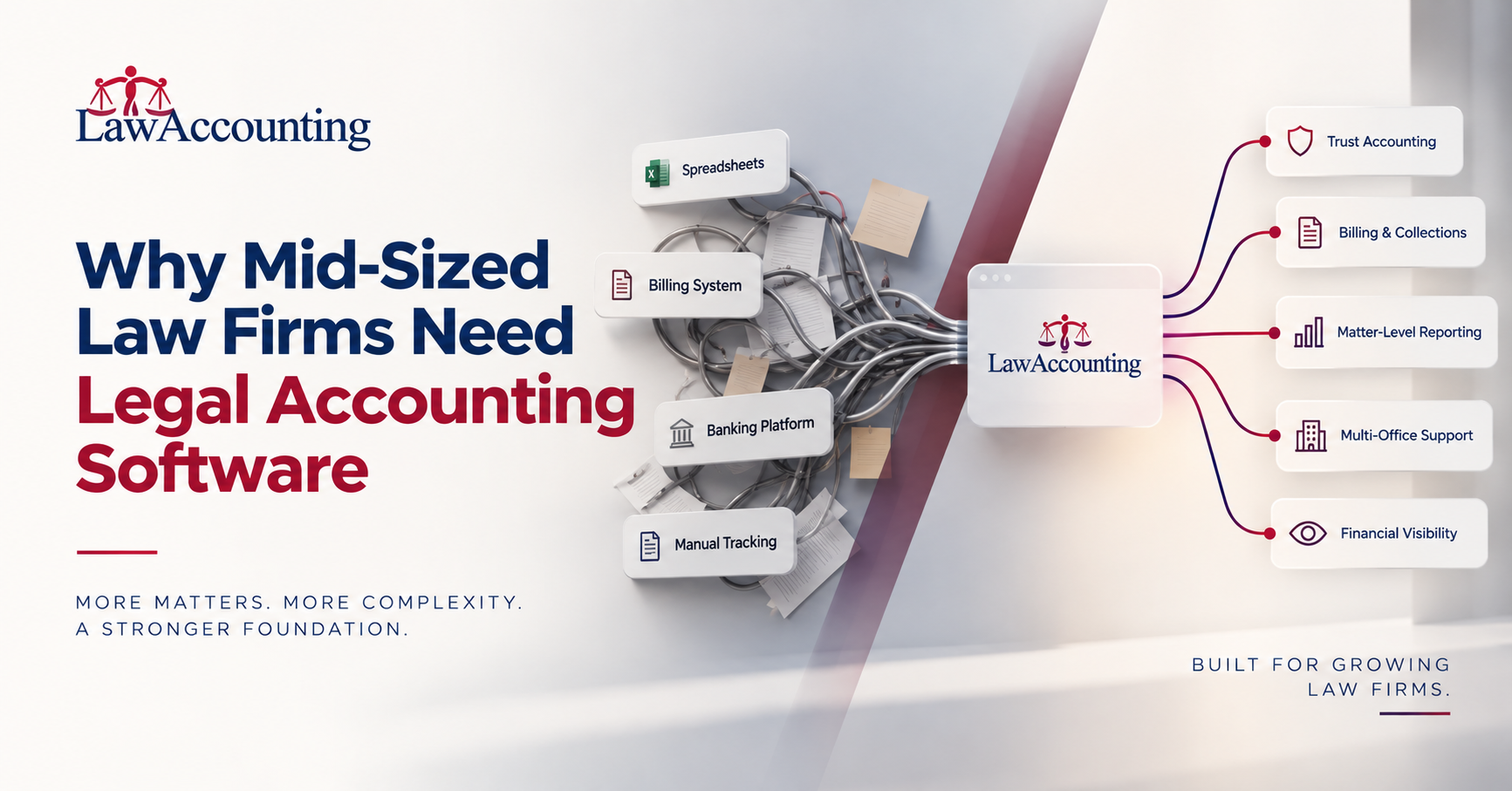
Instead of managing different parts of the firm’s finances through disconnected systems, a legal accounting system brings accounting workflows together while keeping financial activity connected to the clients and matters behind it.
But does every growing law firm need one? And how do you know when it is time to make the switch?
What Is Legal Accounting Software?
Legal accounting software is an accounting system designed around the financial needs of law firms.
It handles the core accounting functions you would expect, such as general ledger accounting, accounts payable, accounts receivable, bank reconciliation, and financial reporting. It also supports legal-specific workflows such as trust and IOLTA accounting, client and matter-level tracking, legal billing, and three-way reconciliation.
The difference is not simply the number of features. It is how those features work together.
For example, a payment should not just appear as money received. Your firm may need to know which client paid, which matter the payment belongs to, which invoice it covers, and how that payment should be reflected in the firm’s financial records.
That legal and matter-level context is what makes law firm accounting software different from a general accounting system.
Has Your Firm Outgrown Its Current Accounting System?
There is no specific number of attorneys at which a firm suddenly needs legal accounting software.
The better question is whether your current accounting process is keeping up with the complexity of your firm.
You may be ready for a change if your finance team is spending significant time moving information between accounting software, billing systems, spreadsheets, and banking platforms.
Another sign is when partners and finance teams cannot quickly get answers to basic financial questions. How much is outstanding? Which matters are most profitable? How much work is still in WIP? What is sitting in trust? Which practice groups are generating the most revenue?
If answering these questions requires pulling data from multiple places, your accounting setup may have become a bottleneck.
The same applies to trust accounting. As the number of clients and matters increases, manually tracking client funds and reconciling trust accounts becomes harder to maintain accurately.
Growth does not automatically mean you need new software. But when your existing process starts creating more manual work than it saves, it is worth looking at a system built for the way your firm operates.
Why Legal Accounting Software Matters for Mid-Sized Law Firms
More matters mean more financial activity to manage
A growing firm does not just have more clients. It has more transactions connected to those clients.
Expenses, payments, invoices, trust transactions, reimbursements, and other financial activity all need to be recorded correctly and connected to the right matter.
Legal accounting software can keep this information together so your team does not have to reconstruct the financial history of a matter from different systems.
Trust accounting becomes harder to manage at scale
Trust accounting requires accuracy at every stage. Funds need to remain separate from operating money, transactions need to be recorded correctly, and client balances need to be clear.
As the number of trust transactions increases, manual processes become harder to control.
A legal accounting system can keep client trust ledgers, trust transactions, transfers, and reconciliation within the same workflow.
Billing and accounting need to work together
Billing is closely connected to a firm’s financial performance.
When billing and accounting operate separately, finance teams may need to move information manually between systems. That can create duplicate work and make it harder to see the relationship between billed work, payments, revenue, and outstanding balances.
A connected system lets billing activity flow into the firm’s financial records, giving your team a more complete picture of what has been billed and collected.
Financial visibility becomes more important
At a certain size, partners need more than a monthly P&L.
They may want to understand revenue by attorney, matter, or practice group. Finance teams may need to monitor AR, WIP, realization, collections, and expenses.
Legal accounting software can bring these financial records together and make them easier to report on.
Multiple offices and entities add another layer of complexity
Growth can also mean more than one office or legal entity.
When financial activity is spread across different entities and locations, maintaining separate records while still getting a consolidated view becomes more difficult.
A system that supports multi-entity and multi-office accounting can help firms maintain the right level of separation while still giving leadership a broader financial view.
Manual processes become expensive
A spreadsheet may seem inexpensive, but the time spent maintaining it is not.
Every manual entry, duplicate record, spreadsheet reconciliation, and report assembled by hand takes time from your finance team. It also creates another opportunity for an error.
Automation cannot replace financial oversight, but it can reduce the amount of repetitive work your team has to perform.
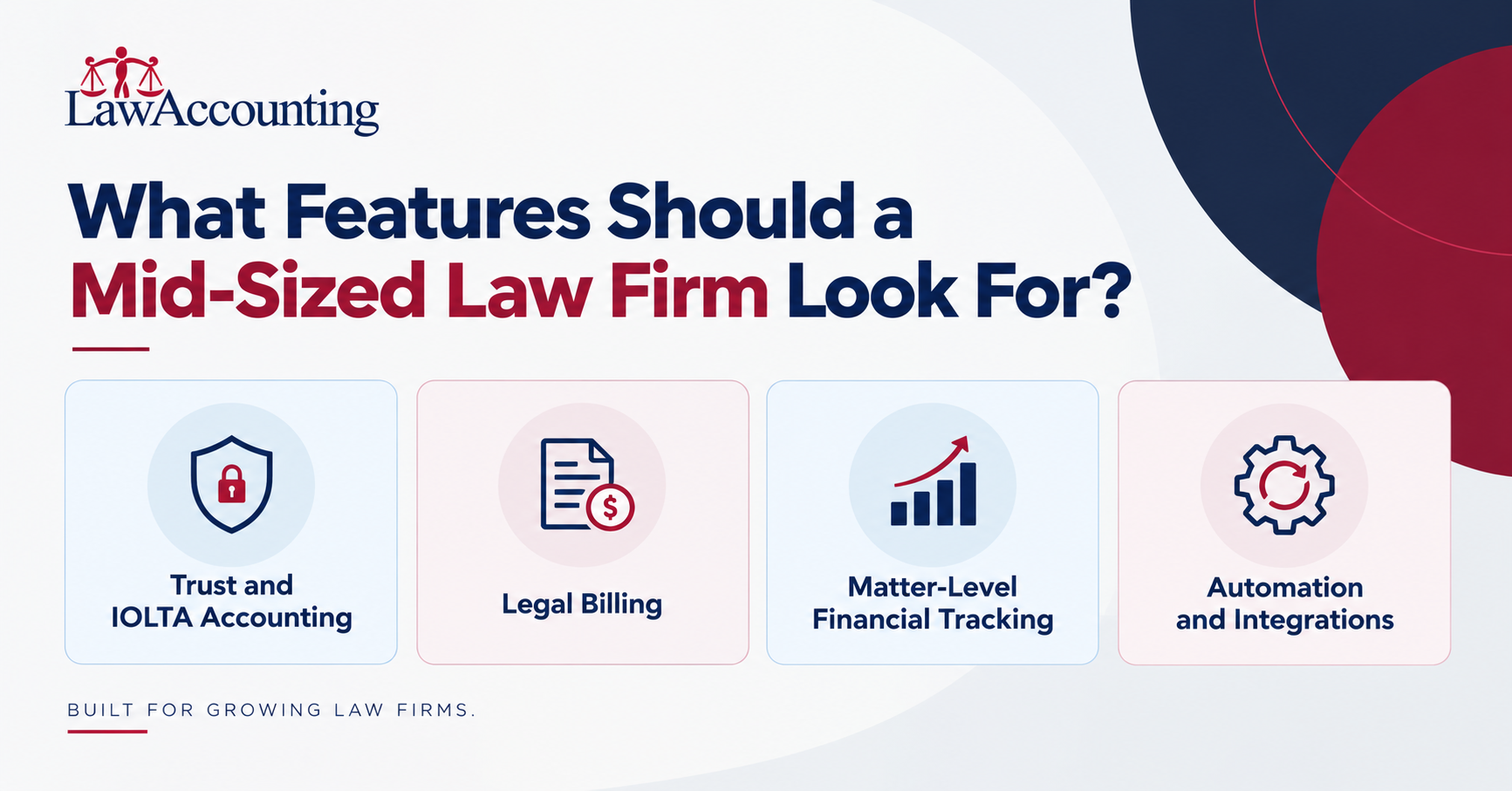
What Features Should a Mid-Sized Law Firm Look For?
Not every firm needs every feature. The right system depends on how your firm operates, but there are several capabilities that become increasingly important as firms grow.
Trust and IOLTA Accounting
If your firm handles client funds, trust accounting should be a priority. Look for software that supports client and matter-level trust ledgers, detailed transaction records, trust-to-operating transfers, and trust reconciliation.
The system should make it easy to understand how much money is being held for each client and how that activity flows through the firm’s records.
Three-Way Reconciliation
Your software should be able to compare the trust bank balance, trust ledger, and individual client ledgers.
For a growing firm, this becomes especially important as transaction volume increases. The right system should make reconciliation easier to perform and investigate when the numbers do not match.
Matter-Level Financial Tracking
Your firm’s financial data should stay connected to the matters it belongs to.
Look for the ability to track matter-level revenue, expenses, payments, receivables, trust activity, and other financial information without having to build separate spreadsheets.
Legal Billing
Mid-sized firms often have more complex billing requirements than a basic invoice workflow can handle.
Depending on your practice, look for support for hourly, flat-fee, contingency, and hybrid billing, as well as pre-bill review, approval workflows, batch invoicing, and e-billing such as LEDES 98B and XML.
General Ledger and Core Accounting
Legal-specific features should not come at the expense of proper accounting.
Your system should provide double-entry accounting, a legal-specific chart of accounts, journal entries, and the ability to manage multiple entities or offices where needed.
AR, Collections, and WIP
Growing firms need visibility into more than invoices.
Your accounting system should help you understand what has been billed, what has been collected, what is outstanding, and how much work is sitting in WIP. Matter-level AR aging, collections tracking, and realization reporting can give finance teams and partners a clearer view of revenue.
Financial Reporting
Look for reporting that goes beyond basic firm-level financial statements.
A useful legal accounting system should allow you to view financial performance across matters, attorneys, and practice groups, along with reports such as P&L, balance sheet, trial balance, AR, and comparative financial reports.
Automation and Integrations
The larger the firm becomes, the more important connected workflows become.
Look for direct bank feeds, transaction matching, recurring journal entries, payment workflows, automated reminders, and integrations with the other systems your firm already uses.
The goal is to reduce the amount of information your team has to enter more than once.
How Much Should a Mid-Sized Law Firm Invest in Legal Accounting Software?
There is no single price that makes sense for every firm.
Legal accounting software can be priced differently depending on the number of users, matters, entities, offices, accounting requirements, integrations, implementation services, and level of support.
Instead of choosing based only on the monthly or annual subscription, look at the total cost of running the accounting process.
For example, consider how much time your finance team currently spends on manual data entry, reconciliation, reporting, payment tracking, and maintaining spreadsheets.
Then consider the cost of errors, duplicate work, disconnected systems, and the additional accounting work that comes with growth.
A more expensive platform may make sense if it replaces several manual processes and gives your team better financial visibility. A cheaper platform may not actually be cheaper if your firm still needs spreadsheets and additional tools to fill the gaps.
What should you ask about pricing?
Before choosing a system, ask whether the quoted price includes implementation, data migration, training, integrations, support, and additional users.
Also ask how pricing changes as your firm grows. A system that looks affordable today may become significantly more expensive when you add offices, entities, users, or additional functionality.
The right question is not: "What is the cheapest legal accounting software?"
It is: "What will this system cost us, and what accounting work will it eliminate?"
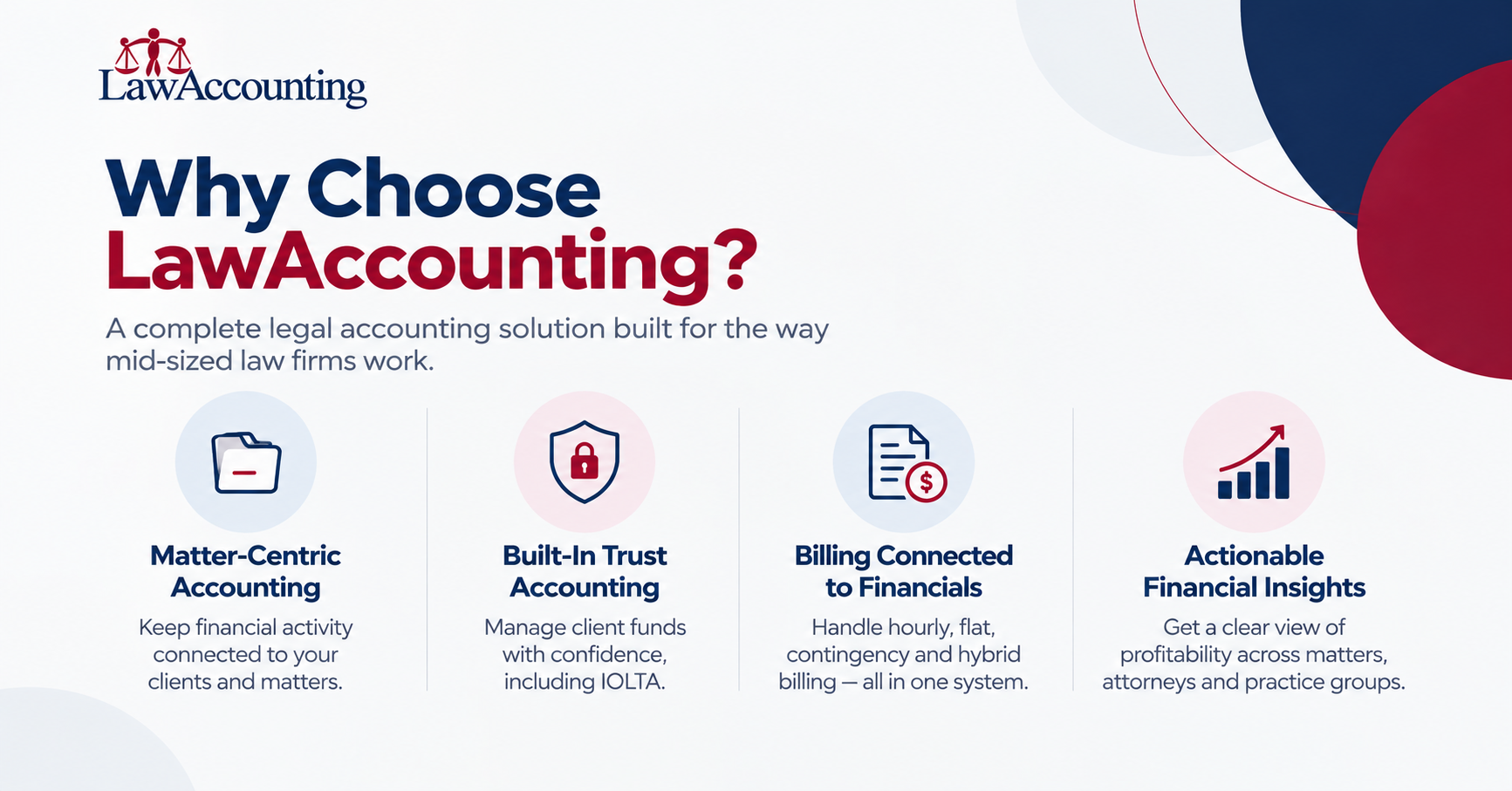
Why Choose LawAccounting?
LawAccounting is built for firms that need more than basic business accounting.
It brings the financial workflows of a law firm into one connected system, including trust and IOLTA accounting, three-way reconciliation, general ledger accounting, billing, AR, AP, expenses, payments, and financial reporting.
Accounting that understands matters
LawAccounting keeps financial activity connected to clients and matters, giving your team more context behind transactions, expenses, payments, revenue, and trust activity.
Built-in trust and IOLTA accounting
Manage client and matter-level trust ledgers, trust transactions, trust-to-operating transfers, and reconciliation without relying on separate spreadsheets.
Complete accounting foundation
Manage your firm’s books with double-entry accounting, a legal-specific chart of accounts, manual and recurring journal entries, and multi-entity and multi-office consolidation.
Billing connected to financials
Handle hourly, contingency, flat, and hybrid billing while keeping billing, payments, revenue, and accounting records connected.
Reporting for growing firms
Get financial visibility across the firm, matters, attorneys, and practice groups. Track P&L, AR, WIP, realization, and other financial information from the same system that manages your accounting.
Less manual work
Bring bank activity into your workflow, match transactions, manage recurring accounting entries, automate payment reminders, and reduce repetitive data entry.
Bottom Line
A growing law firm eventually reaches a point where accounting is too complex to manage through disconnected systems and manual processes.
The right legal accounting software can bring trust accounting, billing, reconciliation, payments, and financial reporting into one connected workflow.
If your firm’s current accounting system is creating more work as you grow, it may be time to move to a system built for legal accounting.
LawAccounting gives growing law firms one place to manage the financial side of the business.
FAQs
Why do mid-sized law firms need legal accounting software?
Mid-sized firms typically manage more clients, matters, transactions, attorneys, and financial workflows than smaller firms. As that complexity grows, managing accounting through general software, spreadsheets, and disconnected systems can create more manual work and make financial reporting harder. Legal accounting software brings these workflows together while supporting legal-specific requirements such as trust accounting, IOLTA, matter-level tracking, billing, and reconciliation.
When should a law firm switch to legal accounting software?
There is no fixed firm size that determines when you should switch. A firm should consider making the change when its current accounting process relies heavily on spreadsheets, duplicate data entry, manual reconciliation, or disconnected billing and accounting systems. Difficulty getting accurate matter-level financial information is another strong sign that the current system may no longer be enough.
Is legal accounting software worth it for a mid-sized law firm?
It can be, particularly when the firm’s accounting processes have become difficult to manage manually. The value comes from more than replacing bookkeeping software. A legal accounting system can reduce duplicate work, connect billing and accounting, simplify trust accounting and reconciliation, and give partners and finance teams better visibility into the firm’s financial performance.
What is the difference between legal accounting software and regular accounting software?
Regular accounting software is designed for general business finances. Legal accounting software is designed around the financial workflows of law firms, including client trust funds, IOLTA accounting, matter-level financial tracking, legal billing, and three-way reconciliation. LawAccounting combines these legal-specific workflows with a full accounting foundation.
What features should a mid-sized law firm look for in accounting software?
At a minimum, look for trust and IOLTA accounting, three-way reconciliation, client and matter-level tracking, legal billing, general ledger accounting, bank reconciliation, AR and collections, AP and expenses, payments, and financial reporting. Mid-sized firms should also consider multi-office and multi-entity support, integrations, automation, user permissions, and scalability.
Can legal accounting software replace QuickBooks?
It depends on how your firm currently uses QuickBooks. QuickBooks can handle general business accounting, but firms with more complex trust accounting, matter-level financial tracking, legal billing, reconciliation, and reporting requirements may need a purpose-built legal accounting system. LawAccounting provides these capabilities within a system designed specifically for law firms.
How much does legal accounting software cost?
The cost varies depending on the software, number of users, firm size, implementation requirements, integrations, and features included in the plan. Mid-sized firms should consider the total cost of ownership rather than comparing subscription prices alone. Implementation, migration, training, support, additional users, and integrations can all affect the overall cost.
Can legal accounting software handle multiple offices and entities?
Yes, some legal accounting systems are designed for firms with multiple offices and entities. When evaluating software, check whether it can keep financial activity properly organized while also providing consolidated reporting. LawAccounting supports multi-entity and multi-office consolidation.
Can legal accounting software help with law firm profitability?
Yes. When financial information is connected to matters, attorneys, and practice groups, firms can get more insight into where revenue and costs are coming from. LawAccounting provides reporting across matters, attorneys, and practice groups, along with visibility into areas such as revenue, WIP, AR, and realization.
Is LawAccounting suitable for growing and mid-sized law firms?
Yes. LawAccounting is designed for law firms that need a complete accounting system rather than basic bookkeeping tools. It combines trust and IOLTA accounting, three-way reconciliation, billing, general ledger accounting, AR, AP, expenses, payments, and financial reporting in one connected platform.