Legal Accounting October 13, 2026 9 min read
1099 Reporting for Law Firms: What to File and When
Last updated: October 2026
Written by Ramit Kaur · Head of Marketing, LawAccounting
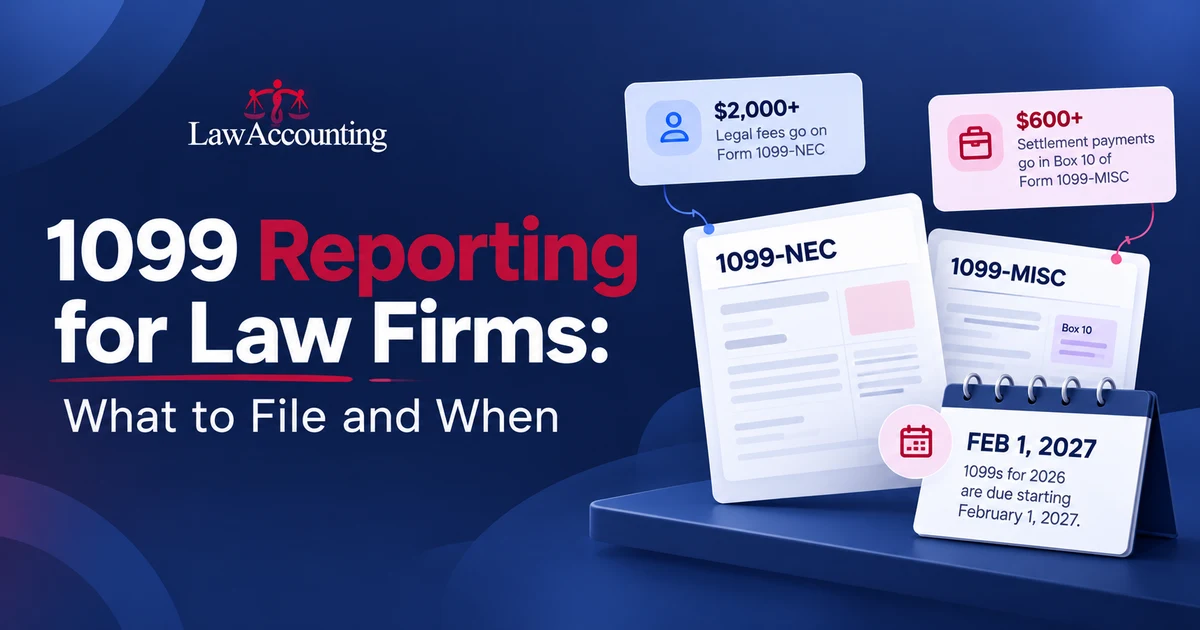
Law firms deal with 1099s from both sides. Your firm sends them to experts, contractors, and other law firms it pays, and receives them from clients, insurers, and businesses that pay you. For payments made in 2026, legal fees of $2,000 or more go on Form 1099-NEC, and settlement money of $600 or more paid to an attorney goes in box 10 of Form 1099-MISC. Forms for 2026 are due starting February 1, 2027.
This guide covers what changed for 2026, which form to use, who reports settlement payments, what doesn't need a 1099, the filing deadlines, and how to keep the process manageable at a mid-size firm.
What changed for 1099s in 2026?
The federal tax law passed in July 2025 raised the reporting threshold for Form 1099-NEC and most boxes on Form 1099-MISC from $600 to $2,000. The new threshold applies to payments made on or after January 1, 2026, and will be adjusted for inflation after 2026.
There are three things to keep straight:
- 2025 payments still use $600. Forms you filed in early 2026 for 2025 payments were under the old threshold.
- Box 10 stays at $600. According to the draft 2026 IRS instructions, gross proceeds paid to attorneys are still reported at $600 or more. Check the final instructions before you file.
- The 1099-K threshold went back up. Card processors and payment apps now issue a 1099-K only above $20,000 and 200 transactions.
Do law firms get 1099s?
Yes. Most payments to corporations don't need a 1099, but that exemption doesn't apply to payments made to attorneys. If a business pays your firm $2,000 or more for legal services in 2026, it should send you a 1099-NEC, whether your firm is a sole proprietorship, partnership, LLC, PC, or corporation.
The rule only applies to payments made in the course of a trade or business. A person paying you for a personal matter, like a divorce or a will, doesn't need to send you one.
Should attorney fees go on a 1099-NEC or 1099-MISC?
It depends on what the payment is for.
- 1099-NEC, box 1: fees paid to an attorney for legal services. This includes payments to co-counsel, fee splits, and referral fees.
- 1099-MISC, box 10: gross proceeds paid to an attorney, usually settlement money paid to a law firm where the payer can't tell how much of it is the firm's fee.
The difference matters to the firm receiving the form. Amounts on a 1099-NEC are treated as the firm's income for services. Amounts in box 10 are not, because most of that money belongs to the client.
What is gross proceeds paid to an attorney?
Gross proceeds are the full amount paid to a lawyer in connection with legal services, usually a settlement or judgment check made out to the firm or to the firm and the client together.
Say a defendant's insurer pays a $300,000 settlement to the plaintiff's law firm. The insurer reports the full $300,000 in box 10 of a 1099-MISC to the firm. The firm's fee may be only $100,000, and the rest goes to the client from the trust account. The firm reports only its fee as income. Box 10 just tells the IRS the money passed through the firm.
Who issues the 1099 for a legal settlement?
Usually the defendant or its insurer, since they're the ones making the payment. In a typical settlement, they send:
- A 1099-MISC to the plaintiff's law firm, with the full settlement amount in box 10
- A 1099-MISC to the plaintiff, usually with the full amount in box 3, if the settlement is taxable
A joint check made out to both the firm and the client generally means a separate 1099 to each payee, each showing the full amount. Settlements for physical injury or physical sickness are generally not taxable to the client, and the payer often doesn't issue the client a 1099 for them.
When your firm receives settlement money into trust and pays the client their share, that distribution generally isn't a new payment by the firm. The firm is only passing along money that already belongs to the client, so it usually doesn't issue the client a 1099. There are exceptions, so ask your CPA when a settlement is structured differently.
Who your firm needs to send 1099s to
For payments your firm makes in 2026, you'll generally need a 1099-NEC for anyone paid $2,000 or more during the year who isn't an employee, including:
- Other law firms and attorneys, for co-counsel, fee splits, and referral fees, even if they're incorporated
- Expert witnesses and consultants
- Investigators
- Court reporters, process servers, and translators, unless they're incorporated
- Freelance paralegals, contract attorneys, and other independent contractors
- IT, marketing, and other service providers that aren't incorporated
Payments to the same vendor add up across the year. Five payments of $500 to one expert total $2,500, so that expert needs a 1099-NEC.
Rent paid to a landlord that isn't a corporation is reported on a 1099-MISC, also at the $2,000 threshold for 2026.
What payments don't need a 1099?
- Card and payment app payments. If you paid a vendor by credit card or through a third-party payment network, the processor reports it on a 1099-K. Don't also send a 1099-NEC.
- Employees. Wages go on a W-2.
- Expense reimbursements to employees under an accountable plan.
- Most corporations, unless the payment is to an attorney or law firm.
- Refunds of unused retainers. Returning a client's own money from trust isn't a payment for services.
- Payments below the threshold for the year.
When are 1099s due for 2026?
For payments made in 2026:
- 1099-NEC: due to both recipients and the IRS by February 1, 2027. The usual January 31 deadline moves because it falls on a Sunday.
- 1099-MISC: recipient copies are generally due February 1, 2027, or by mid-February if you're reporting box 10 amounts. The IRS copy is due March 1, 2027 on paper or March 31, 2027 if you file electronically.
- W-2s: also due February 1, 2027.
If your firm files 10 or more information returns in total, counting 1099s and W-2s together, you have to file electronically. Many states also require their own copy of 1099s, so check your state's rules. Penalties are charged per form and grow the later a form is filed.
What happens if a vendor won't give a W-9?
You'll need to start backup withholding. That means holding back 24% of each payment and sending it to the IRS. A payment you backup-withheld on has to be reported on a 1099, even if the total is under the threshold.
The easiest way to avoid this is to collect a W-9 before you pay anyone. Make it part of setting up a new vendor, and don't release payment until you have it. For co-counsel and experts on a case, request the W-9 when they're engaged, not when the settlement closes.
How to handle 1099s your firm receives
In January and February, your firm will receive 1099s from clients, insurers, and other businesses. Before you give them to your CPA:
- Match every 1099-NEC to the fees your records show from that payer.
- Treat box 10 amounts separately. Match them to the settlement deposits in your trust account, and report only your fee as income.
- Ask the payer for a corrected form if an amount is wrong.
- Keep a list of every 1099 received, so nothing is left out of the firm's tax return.
The IRS matches 1099s to tax returns, so an unexplained gap between the 1099s your firm received and the income you reported can lead to a notice.
A 1099 process for mid-size firms
At a firm with 20 to 100 users, payments come from billing, accounts payable, and the trust account, often handled by different people. A few habits keep 1099s accurate:
- Keep one clean vendor list. Each vendor should have one record, with their W-9, tax ID, entity type, and whether they're an attorney.
- Tag reportable payments when you make them. Mark the form and box at payment time, including payments from trust.
- Review the vendor report in November. Find missing W-9s while there's still time to get them. Our law firm year-end close checklist has the full timeline.
- Have someone review the 1099s before they're filed. Check totals against last year and look into big differences.
- Reconcile 1099s received. Assign one person to match incoming forms against firm records.
How LawAccounting fits
LawAccounting is our product, so read this with that in mind.
LawAccounting keeps billing, trust accounting, payments, and the firm's books in one platform. Because trust disbursements and operating payments live in the same system, it's easier to see what was paid to whom from each account when you're preparing 1099s.
FAQ
What is the 1099 threshold for 2026?
$2,000 for Form 1099-NEC and most 1099-MISC boxes. Gross proceeds paid to attorneys in box 10 are still reported at $600.
Do attorneys get a 1099 if they are a corporation?
Yes. The usual corporate exemption doesn't apply to payments to attorneys and law firms.
Should referral fees go on a 1099-NEC or 1099-MISC?
Referral fees and co-counsel fees are payments for legal services, so they generally go on a 1099-NEC.
Does a law firm issue a 1099 to its client after a settlement?
Usually not. The defendant or insurer is generally the payer, and the firm is only passing the client's share along from trust. Check with your CPA on unusual settlements.
Do you need a 1099 for payments made by credit card?
No. Card and payment app payments are reported by the processor on a 1099-K.
When are 1099-NEC forms due for 2026?
February 1, 2027, both to recipients and to the IRS.
What if a vendor won't provide a W-9?
You'll have to withhold 24% of each payment as backup withholding and report it on a 1099.