Legal Accounting October 13, 2026 9 min read
Law Firm Year-End Close Checklist for 2026
Last updated: October 2026
Written by Ramit Kaur · Head of Marketing, LawAccounting
A law firm's year-end close comes down to four jobs: bill and collect everything you can before December 31, reconcile every bank and trust account, review the year's financial reports, and file 1099s and W-2s on time. Most firms try to do all of it in the last two weeks of December. It goes much more smoothly when you start in November.
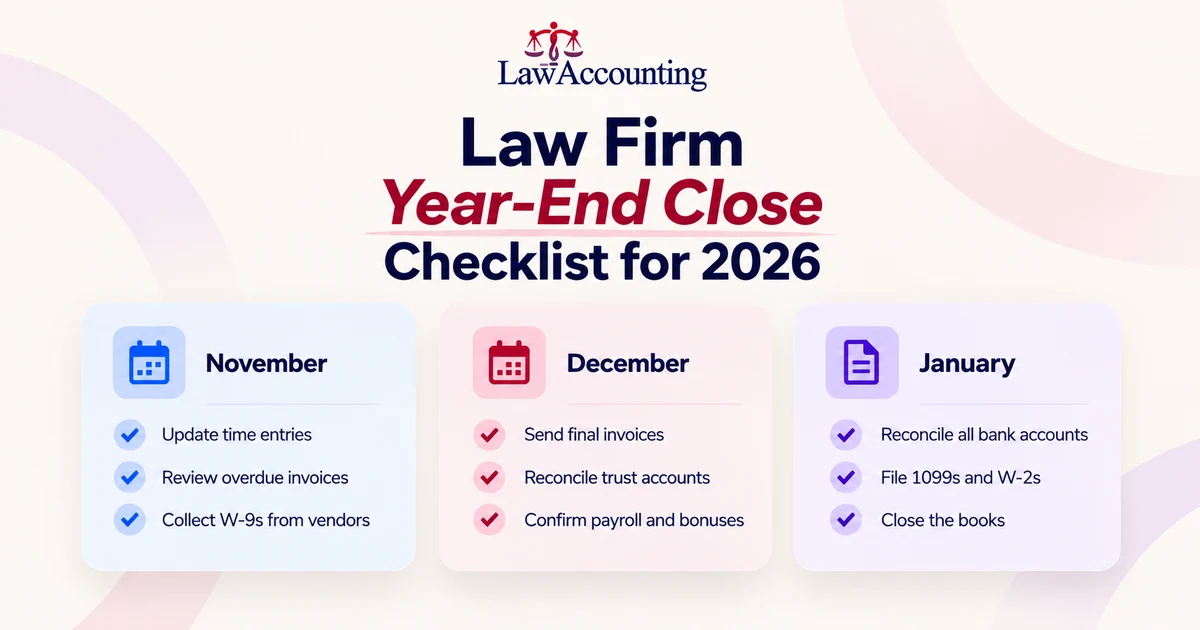
This checklist splits the work into November, December, and January, with notes on who usually owns each task. It also covers the 1099 changes for 2026, the trust account steps most checklists skip, and the extra work a mid-size firm has at year-end.
| When | What to focus on |
|---|---|
| November | Clean up data, chase old invoices, collect W-9s |
| December | Final billing, collections, trust account cleanup |
| January | Reconcile, review reports, close the books, file 1099s and W-2s |
When should a law firm start its year-end close?
Start in early November. Many of the slowest tasks, like collecting W-9s, chasing overdue invoices, and cleaning up client ledgers, depend on other people responding. Holidays make that harder in December, and attorneys take time off right when you need their time entries.
The final close happens in January, after December's bank statements arrive. Most firms aim to finish within the first two to three weeks of the new year, so the CPA has what they need for tax returns.
November checklist: get ahead
- Ask attorneys and staff to bring time entries up to date
- Run an accounts receivable aging report and follow up on invoices over 60 days old
- Identify invoices that won't be collected and decide on write-offs with your CPA
- Run a vendor report of everyone you paid this year, and request W-9s from any vendor you don't have one for
- Review open matters and close the ones that are finished
- Check trust balances on closed or inactive matters
- Schedule time with your CPA for year-end tax planning
Who handles it: billing team and accounting, with partners following up on their own clients' overdue invoices.
December checklist: billing, collections, and trust
- Send final invoices early in the month, so clients can pay before year-end
- Finalize unbilled time and expenses through December 31
- Apply earned fees from trust to open invoices, where your engagement terms allow
- Refund unearned retainers on closed matters
- Record all bills received in December
- If you're on cash basis, talk to your CPA about timing. Paying expenses before December 31 or collecting payments early changes which year they count in. Our guide to cash vs accrual accounting for law firms explains why.
- Confirm payroll dates and any year-end bonuses with your payroll provider
Who handles it: billing team, accounting, and the managing partner for any bonus or distribution decisions.
What trust account steps should a law firm take at year-end?
Trust accounts need the most care at year-end, because errors here can lead to bar complaints. Work through these:
- Run the December three-way reconciliation. The adjusted bank balance, the trust ledger, and the total of client ledgers should match. See our three-way reconciliation guide for the steps.
- Check every client ledger. No client should have a negative balance.
- Close out finished matters. Closed matters should show a zero trust balance. Refund what's left or transfer earned fees.
- Look into small leftover balances. Old balances you can't return to a client have to be handled under your state's rules, which may include unclaimed property laws.
- Look into checks that haven't cleared. Contact the payee for any trust check outstanding for more than a few months.
- Complete any annual trust certification. Many states ask lawyers to certify IOLTA compliance each year, often with bar registration.
- Send annual trust statements to clients if your state requires them.
- Save the year's reconciliation reports with your trust records.
If your firm holds more than one trust account, do each step for each account separately.
How do you close the books at a law firm?
Once December bank and credit card statements arrive, close the year in this order:
- Reconcile every operating, payroll, and credit card account through December 31.
- Record bank fees, interest, and any card rewards.
- Confirm all client costs are tied to the right matter.
- Review advanced client costs and write off any you won't recover, as your CPA directs.
- Record depreciation on equipment and other fixed assets.
- If you report on accrual, record bills owed and fees earned but not yet paid.
- Run a trial balance and fix anything that looks wrong.
- Send the trial balance to your CPA for review and adjusting entries.
- Lock the period in your accounting software, so no one can post to the closed year by mistake.
Who handles it: accounting manager or controller, with the outside CPA.
What reports should a law firm run at year-end?
| Report | What to check |
|---|---|
| Balance sheet | Trust bank accounts equal trust liability. No odd balances. Partner capital and loans are correct. |
| Profit and loss | Fee income by type, client costs separated from overhead, no duplicate expense accounts |
| AR aging | Old invoices to collect or write off |
| WIP (unbilled time) | Work that should be billed |
| Trust listing by client | Every balance is accurate and none is negative |
| Partner draws and capital | Each partner's draws and contributions for the year |
| Vendor payment report | Who needs a 1099 |
Compare each report with last year. A big change in an expense account or a partner's draws is easier to explain in January than in April.
What is the 1099 threshold for 2026?
For payments made in 2026, the reporting threshold for Form 1099-NEC and most boxes on Form 1099-MISC rises from $600 to $2,000. The change came from the federal tax law passed in July 2025, and the amount will be adjusted for inflation after 2026. If you paid an independent contractor less than $2,000 during 2026, you generally don't need to send them a 1099-NEC.
There's one exception that matters to law firms. Gross proceeds paid to attorneys, such as settlement funds paid to another firm, go in box 10 of Form 1099-MISC. IRS guidance for 2026 still lists $600 for that box. Check the final 2026 instructions before you file.
Do law firms need to send 1099s to attorneys?
Yes. Most payments to corporations don't need a 1099, but payments to attorneys and law firms do, even if they're incorporated. Fees for legal services go on Form 1099-NEC. Gross proceeds, like settlement money paid to co-counsel or an opposing firm, go on Form 1099-MISC.
Key dates for 2026 forms:
- 1099-NEC and W-2s: due February 1, 2027, because January 31 falls on a Sunday
- 1099-MISC: deadlines vary by box, so check the IRS instructions
- E-filing: required if you file 10 or more information returns in total
We cover this in more detail in our guide to 1099 reporting for law firms.
Extra year-end steps for mid-size firms
At a firm with 20 to 100 users, year-end involves more accounts, more people, and more reports.
- Reconcile each trust account separately. A pooled IOLTA plus separate interest-bearing accounts means several reconciliations, each with its own review and sign-off.
- Allocate profit to partners. Confirm each partner's capital, draws, and share of profit match the partnership agreement before the CPA prepares K-1s.
- Record accrual adjustments. Partners and lenders often want accrual statements even if taxes are filed on cash.
- Run reports by office and practice group. Check that transactions were tagged correctly during the year, so the reports are reliable.
- Prepare lender reports. If your line of credit has reporting requirements, find out what the bank needs and when.
- Assign owners and deadlines. Put every task on a shared list with one person responsible and a due date.
How long should a law firm keep trust account records?
The ABA's model rules suggest keeping trust account records for five years after a representation ends. Many states require the same or longer, so check your state's rules. Keep the monthly three-way reconciliation reports, bank statements, client ledgers, and records of every deposit and payment.
Year-end is a good time to archive the past year's records and to securely destroy records that are past your retention period.
What is the difference between month-end and year-end close?
Month-end close covers reconciling accounts, reviewing the month's reports, and fixing errors. Year-end close does all of that for December, plus tax reporting (1099s and W-2s), partner allocations, depreciation, write-offs, CPA adjustments, and locking the year.
If your month-end close is done well all year, year-end is mostly the extra tax and partner work. If reconciliations have been skipped, year-end means fixing twelve months of problems at once.
How LawAccounting helps with year-end
LawAccounting is our product, so read this with that in mind.
LawAccounting keeps trust accounting, billing, and the firm's books in one platform. IOLTA trust accounting with three-way reconciliation, LEDES billing, and matter-level financial reports all work from the same data, so year-end reports don't depend on matching exports from separate systems.
For help choosing a system, see our guide to the best accounting software for mid-size law firms.
FAQ
What should a law firm do at year-end?
Bill and collect what you can, reconcile every bank and trust account, review the year's reports, close the books with your CPA, and file 1099s and W-2s.
When should a law firm start its year-end close?
Early November. The final close happens in January, once December statements arrive.
What is the 1099 threshold for 2026?
$2,000 for Form 1099-NEC and most 1099-MISC boxes. Gross proceeds paid to attorneys (box 10) are still listed at $600.
Do I need to send a 1099 to a law firm that's a corporation?
Yes. Payments to attorneys and law firms are reportable even when the firm is incorporated.
What trust account steps should be done at year-end?
Run the December three-way reconciliation, check that no client balance is negative, zero out closed matters, handle old balances under your state's rules, and complete any annual trust certification.
How long should a law firm keep trust records?
The ABA's model rules suggest five years after the representation ends. Your state may require longer.