Legal Accounting October 13, 2026 8 min read
Cash vs Accrual Accounting for Law Firms: Which Should You Use?
Last updated: October 2026
Written by Ramit Kaur · Head of Marketing, LawAccounting
Most small law firms use cash basis accounting, and most firms can keep using it for taxes no matter how much they grow. Cash basis records income when a client pays and expenses when the firm pays them. Accrual accounting records income when you earn it and expenses when you owe them, which gives partners a truer picture of how the firm is doing.
Many mid-size firms end up using both: cash for the tax return and accrual reports for managing the firm. This guide explains the difference with a worked example, the IRS rules, how trust funds and unbilled time fit in, and how to decide.
What is the difference between cash and accrual accounting for a law firm?
The difference is timing.
| Cash basis | Accrual basis | |
|---|---|---|
| Income is recorded | When the client pays | When the fee is earned and billed |
| Expenses are recorded | When the firm pays them | When the firm receives the bill |
| Shows accounts receivable | No | Yes |
| Shows bills the firm owes | No | Yes |
| Best at showing | Cash on hand | Profit for the period |
Under cash basis, a $20,000 invoice sent in March and paid in May is May income. Under accrual, it's March income, and it sits in accounts receivable until May.
Cash vs accrual accounting example
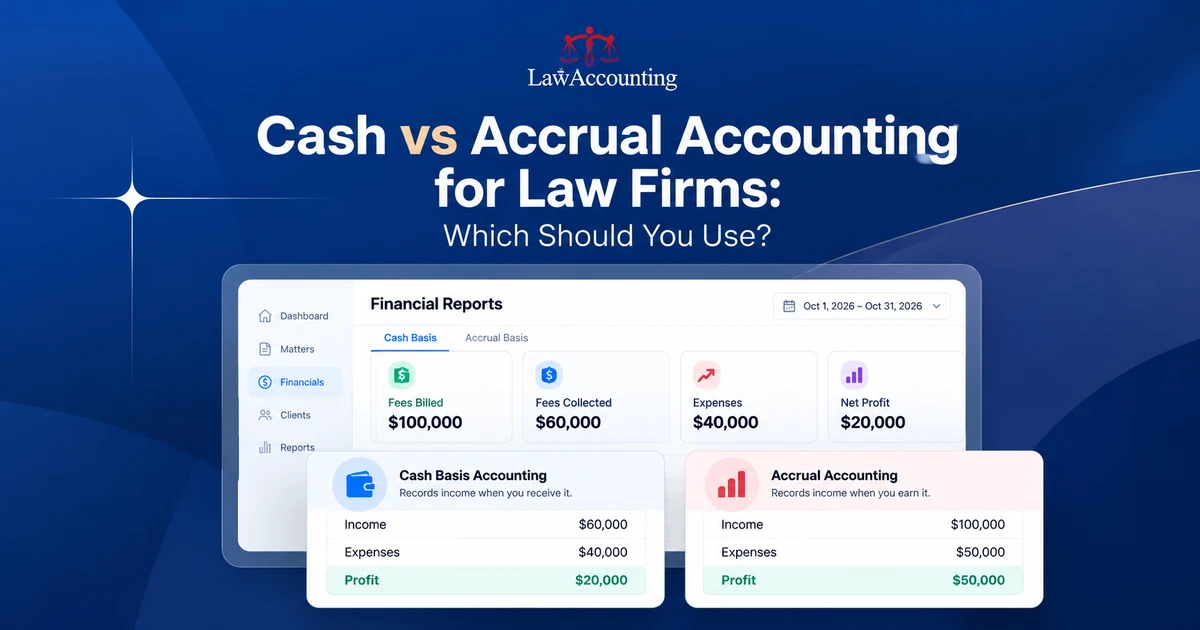
Here's one month at a made-up firm, recorded both ways. In October, the firm:
- Billed $100,000 in fees
- Collected $60,000 of those fees
- Received $50,000 in bills for rent, payroll, and vendors
- Paid $40,000 of those bills
- Deposited a $25,000 retainer into trust
| October | Cash basis | Accrual basis |
|---|---|---|
| Income | $60,000 | $100,000 |
| Expenses | $40,000 | $50,000 |
| Profit | $20,000 | $50,000 |
| Retainer in trust | $0 income | $0 income |
Cash basis shows what actually moved through the bank. Accrual shows the work the firm did and the costs it took on, even though $40,000 hasn't been collected yet. Neither method counts the $25,000 retainer as income.
How are retainers and trust funds treated under each method?
The same way under both. Money in a trust account belongs to the client, so it's a liability on the firm's books, not income. A retainer only becomes the firm's income once the fee is earned and moved from trust to the operating account.
This is where general accounting advice often goes wrong for law firms. If trust deposits are recorded as income, revenue looks higher than it is, and the trust account won't reconcile. Our law firm chart of accounts guide shows how to set up the trust liability account, and our three-way reconciliation guide covers the monthly check.
Can a law firm use the cash method for taxes?
In most cases, yes. Under Section 448 of the tax code, the businesses generally barred from using cash for taxes are C corporations, partnerships that have a C corporation as a partner, and tax shelters. There are two main exceptions:
- Qualified personal service corporations. The code names law as one of the qualifying fields, so a law firm set up as a corporation and owned by its lawyers can generally use cash.
- The gross receipts test. A business with average annual gross receipts of $32 million or less over the prior three years (the 2026 limit, adjusted for inflation each year) can use cash.
A law firm partnership or LLC owned only by individual lawyers isn't on the restricted list to begin with. So the revenue limit you'll see in other articles applies to far fewer firms than they suggest.
The ABA's Law Practice Today makes the same point: law firms can generally use the cash method regardless of revenue. Your entity type and ownership decide which rules apply to you, so confirm with your CPA.
Do most law firms use cash or accrual accounting?
Most small firms use cash basis. It's simpler to keep, it matches the bank balance, and it means the firm only pays tax on money it has collected. That last point matters at a law firm, where clients can take months to pay.
The downside is that cash basis can hide problems. A firm can have a strong month in the bank while unpaid invoices pile up, or a slow month that's only slow because a large client paid late.
Why mid-size firms often add accrual reporting
As a firm grows past 20 or so users, more people need to know how the firm is actually doing, and cash reports stop answering their questions.
- Partners want profit by practice group and partner based on work done, not on when clients happened to pay.
- Banks and lenders often ask for accrual financial statements before extending a line of credit.
- Auditors and investors usually expect GAAP statements, which use accrual.
- Firm management needs to see accounts receivable, aged balances, and bills owed to manage cash flow.
Accrual also handles timing better. If a firm pays a big expert fee in December for a trial in February, cash basis shows a December loss. Accrual matches the cost to the period it relates to.
Can a law firm use accrual for reports and cash for taxes?
Yes, and many firms do. The method on your tax return and the method in your management reports don't have to be the same. A common setup is to file taxes on cash basis and give partners accrual reports each month.
This is easiest when your accounting software can produce both reports from the same records. If your team has to rebuild accrual numbers in a spreadsheet every month, that work adds up. Our guide to the best accounting software for mid-size law firms covers what to look for.
What is modified cash basis accounting?
Modified cash basis is mostly cash, with a few accrual-style entries. A firm might record income and most expenses on a cash basis but record equipment as an asset and depreciate it, or record payroll taxes when they're owed.
Firms use it to get some of the accuracy of accrual without the full workload. It's mainly used for internal and lender reporting. For taxes, ask your CPA what's allowed for your firm.
How do unbilled time and contingency fees work?
Unbilled time (WIP). Work done but not yet billed doesn't show up as income under cash basis. Under accrual, many firms track it as work in progress on the balance sheet so partners can see what's coming. We cover this in our guide to what WIP is at a law firm.
Contingency fees. Under either method, a contingency fee usually isn't income until the case resolves and the firm has a right to the fee. Case costs the firm pays up front are tracked as advanced client costs or expenses, depending on the method your CPA recommends.
How do you switch from cash to accrual accounting?
For your management reports, you can start producing accrual reports at any time, as long as your system tracks receivables and bills owed.
For taxes, changing your method generally requires filing IRS Form 3115. The switch usually creates a one-time adjustment, since income already earned but not collected gets counted. The IRS often lets firms spread a positive adjustment over four years. Plan the switch with your CPA, ideally before the start of a tax year.
Do Canadian law firms have to use accrual accounting?
Mostly, yes. Canadian lawyers used to be able to elect billed-basis accounting, which left unbilled work in progress out of income. The 2017 federal budget removed that option, and WIP was phased into income over five years. The CRA indicated that unbilled amounts on genuine contingency fee arrangements generally wouldn't be taxed until the right to the fee is established. Ask your accountant how this applies to your firm.
Which method should your law firm use?
- Solo and small firms: Cash basis is usually enough, as long as you track receivables separately.
- Growing firms: Keep cash for taxes, but start running accrual reports if partners need profit by matter or practice group.
- Mid-size firms (20 to 100 users): Use accrual for management and lender reporting, and choose your tax method with your CPA based on your entity type.
- Firms seeking a loan or an audit: Expect to need accrual statements.
How LawAccounting fits
LawAccounting is our product, so read this with that in mind.
LawAccounting keeps trust accounting, billing, and the firm's general ledger in one platform, with financial reporting down to the matter level. Because trust funds and the firm's books live in the same system, retainers stay in the trust liability until they're earned and transferred, so they don't get counted as income.
FAQ
Should a law firm use cash or accrual accounting?
Small firms usually do fine with cash. Mid-size firms often file taxes on cash and use accrual reports to manage the firm.
Is there an IRS revenue limit for cash basis law firms?
The $32 million gross receipts test (2026) applies mainly to C corporations and partnerships with a C corporation partner. Qualified personal service corporations and most partnerships owned by individual lawyers can generally use cash at any size.
Are client retainers income under cash basis?
No. Under both methods, money in trust is a liability until the fee is earned and transferred to operating.
Which method shows a firm's real profit?
Accrual, because it matches income and expenses to the period when the work was done.
Can I switch accounting methods mid-year?
Changing your tax method generally requires IRS Form 3115 and is usually done at the start of a tax year. You can add accrual management reports at any time.