Legal Accounting October 7, 2026 9 min read
Law Firm Chart of Accounts: What to Include (With a Template)
Last updated: October 2026
Written by Ramit Kaur · Head of Marketing, LawAccounting
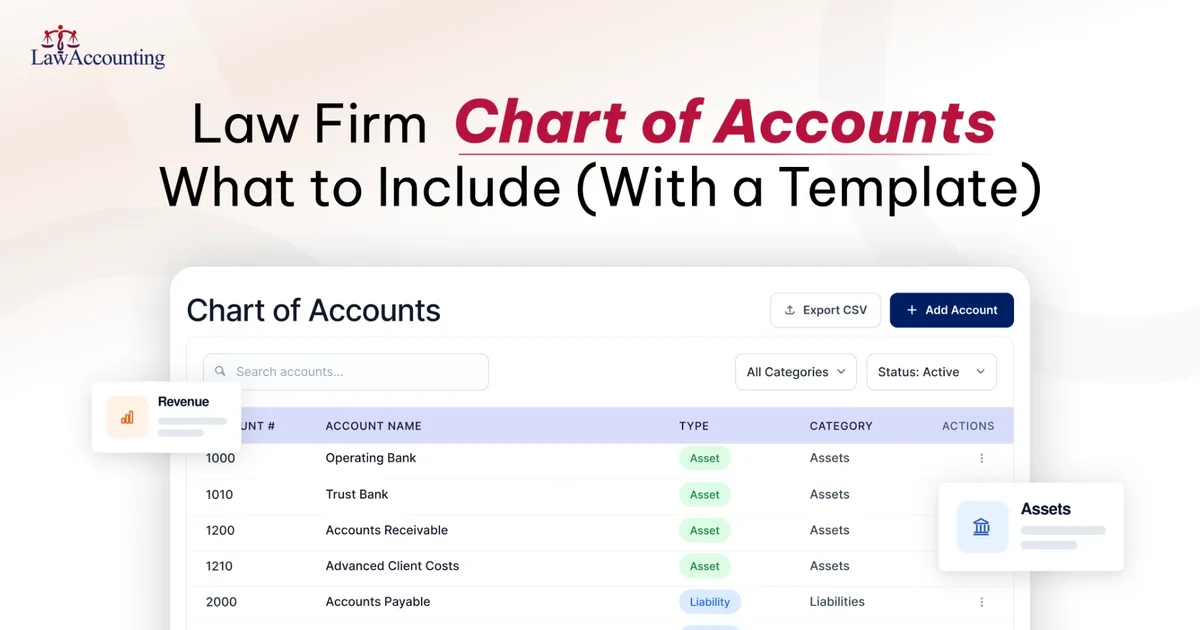
A law firm chart of accounts is the list of every account your firm uses to record money coming in and going out, grouped into assets, liabilities, equity, revenue, and expenses. What makes it different from a regular business chart is client money. A law firm needs accounts for trust funds that belong to clients, a matching trust liability, and a way to track costs it pays on clients' behalf.
Most sample charts online are built for a small firm with one bank account, one trust account, and a few partners. This guide is for firms with 20 to 100 users that need more: multiple trust accounts, accrual reporting, partner capital tracked by partner, and reports by office or practice group. It covers what to include, how to number your accounts, the mistakes to avoid, and a full template you can adapt.
What accounts should a law firm chart of accounts include?
A law firm chart of accounts includes the same five groups as any business, plus a few legal-specific accounts in each:
- Assets include your operating bank accounts, trust bank accounts, accounts receivable, and advanced client costs if you record them as an asset.
- Liabilities include accounts payable, payroll liabilities, loans, and the client trust liability, which shows that money in trust belongs to clients.
- Equity includes partner capital, partner draws, and retained earnings.
- Revenue includes fee income, split by fee type, and reimbursed client costs.
- Expenses include personnel, rent, insurance, technology, and client costs the firm won't recover.
How is a law firm chart of accounts different from a regular business one?
A regular business owns all the money in its bank accounts. A law firm doesn't. Client funds in trust sit in the firm's bank but belong to clients, so the chart of accounts needs a way to show that money as owed, not owned.
That's the job of the trust liability account. Every dollar in a trust bank account (an asset) is matched by a dollar in the trust liability account. When the two agree, the firm's balance sheet shows trust money correctly. If trust money is recorded as income instead, the firm overstates its revenue, and the trust account can't be reconciled.
The second difference is client costs. Law firms often pay filing fees, expert fees, deposition costs, and similar expenses for clients and bill them back later. A regular chart of accounts would treat those as overhead. A law firm chart needs separate accounts so recoverable costs don't get lost in general expenses.
What is a trust liability account?
A trust liability account records how much money the firm holds for clients. It sits on the liability side of the balance sheet and should always equal the balance of the trust bank account it matches.
When a client deposits a $10,000 retainer into trust, two entries happen: the trust bank account goes up by $10,000, and the trust liability goes up by $10,000. When the firm earns $3,000 of that retainer and moves it to operating, both go down by $3,000. The firm's own money only increases once the fee is earned and transferred.
Each client's share of the trust liability is tracked in a client trust ledger. This is the third piece of a three-way trust reconciliation, where the trust bank balance, the trust liability, and the total of client ledgers all have to match. We explain that process in our guide to three-way reconciliation for law firm trust accounts.
Should advanced client costs be recorded as an asset or an expense?
Firms do it both ways, and the choice affects how your profit is reported and can affect your taxes.
The asset method records costs paid for a client as advanced client costs, an asset, because the client is expected to pay them back. When the client reimburses the firm, the asset goes down. Your profit and loss statement isn't affected, and the balance sheet shows how much money is tied up in unreimbursed costs.
The expense method records the cost as an expense when it's paid and records income when the client reimburses it. It's simpler, and some firms prefer it, but it can make profit swing from month to month, especially on contingency matters where costs are paid long before they're recovered.
Whichever method you use, keep client costs separate from firm overhead. A common split, used in a DC Bar presentation on legal accounting, separates reimbursable costs from non-reimbursable ones and breaks matter costs into hard costs paid to outside parties and soft costs like in-house copying. Talk to your CPA before choosing a method or switching between them.
How should a law firm number its accounts?
Use a numbering system with one range for each group and gaps between accounts so you have room to add more later. A common structure:
- 1000 to 1999: Assets
- 2000 to 2999: Liabilities
- 3000 to 3999: Equity
- 4000 to 4999: Revenue
- 5000 to 5999: Client costs
- 6000 to 6999: Personnel expenses
- 7000 to 7999: Operating expenses
- 8000 to 8999: Other income and expenses
Number accounts in steps of 10 (1010, 1020, 1030), not 1, 2, 3. When you open a second trust account or add a new fee type, you can slot it in without renumbering. Keep related accounts together, such as each trust bank account near the others, so reports read in a logical order.
How do you track multiple offices or practice groups in a chart of accounts?
Don't create separate accounts for each office or practice group. If you have three offices and 60 expense accounts, duplicating them gives you 180 accounts, and every new office makes the chart harder to manage.
Instead, keep one set of accounts and tag each transaction with its office, practice group, or department. Most accounting software calls these classes, departments, dimensions, or segments. You can then run a profit and loss by office or practice group from the same chart of accounts.
The same idea applies to clients. At a mid-size firm with hundreds of clients in trust, creating a separate general ledger account for each client isn't practical. Keep one trust liability account per trust bank account, and track each client's balance in client trust ledgers inside your trust accounting system.
What changes at a mid-size firm?
A few accounts matter more once a firm grows past a handful of lawyers.
Multiple trust accounts. Many mid-size firms hold a pooled IOLTA account plus separate interest-bearing trust accounts for large or long-term funds. Give each trust bank account its own trust liability account so each can be reconciled on its own.
Accrual accounts. Firms that report on an accrual basis need accounts for unbilled time (often called work in progress or WIP) and for money received before it's earned. These show work done but not yet billed, and income not yet earned, which a cash-basis chart doesn't capture.
Partner capital and draws by partner. With several partners, track each partner's capital and draws in separate accounts or sub-accounts. It makes year-end partner allocations easier and prevents disputes about who took what.
Partner loans. If partners lend money to the firm, record those as liabilities, not capital, so the balance sheet shows what the firm owes.
Law firm chart of accounts template
Here's a template built for a mid-size firm. Rename, remove, or add accounts to match how your firm works.
Assets (1000 to 1999)
| Number | Account |
|---|---|
| 1010 | Operating account |
| 1020 | Payroll account |
| 1030 | Reserve or savings account |
| 1110 | IOLTA / pooled trust account |
| 1120 | Separate interest-bearing trust account |
| 1210 | Accounts receivable, fees |
| 1220 | Allowance for uncollectible fees |
| 1250 | Unbilled time (WIP) |
| 1310 | Advanced client costs (asset method only) |
| 1410 | Prepaid expenses |
| 1510 | Furniture and equipment |
| 1520 | Computer equipment |
| 1530 | Leasehold improvements |
| 1590 | Accumulated depreciation |
Liabilities (2000 to 2999)
| Number | Account |
|---|---|
| 2010 | Accounts payable |
| 2110 | Trust liability, IOLTA |
| 2120 | Trust liability, separate trust account |
| 2210 | Unearned retainers (only where your rules allow funds outside trust) |
| 2310 | Payroll liabilities |
| 2410 | Accrued expenses |
| 2510 | Line of credit |
| 2610 | Partner loans to firm |
| 2710 | Long-term debt |
Equity (3000 to 3999)
| Number | Account |
|---|---|
| 3010 | Partner capital, Partner A |
| 3020 | Partner capital, Partner B |
| 3110 | Partner draws, Partner A |
| 3120 | Partner draws, Partner B |
| 3510 | Retained earnings |
Revenue (4000 to 4999)
| Number | Account |
|---|---|
| 4010 | Fee income, hourly |
| 4020 | Fee income, flat fee |
| 4030 | Fee income, contingency |
| 4110 | Reimbursed client costs |
| 4210 | Interest income (operating accounts only) |
| 4310 | Other income |
Client costs (5000 to 5999)
| Number | Account |
|---|---|
| 5010 | Reimbursable client costs, hard costs (expense method only) |
| 5020 | Reimbursable client costs, soft costs |
| 5030 | Non-reimbursable client costs |
| 5040 | Unrecovered client costs written off |
Personnel expenses (6000 to 6999)
| Number | Account |
|---|---|
| 6010 | Attorney salaries |
| 6020 | Paralegal and staff salaries |
| 6030 | Payroll taxes |
| 6040 | Employee benefits |
| 6050 | Recruiting |
| 6060 | CLE and training |
Operating expenses (7000 to 7999)
| Number | Account |
|---|---|
| 7010 | Rent |
| 7020 | Professional liability insurance |
| 7030 | Other insurance |
| 7040 | Technology and software |
| 7050 | Legal research |
| 7060 | Bar dues and licenses |
| 7070 | Marketing |
| 7080 | Office supplies |
| 7090 | Accounting and professional fees |
| 7100 | Bank fees, operating accounts |
| 7110 | Travel |
Other income and expenses (8000 to 8999)
| Number | Account |
|---|---|
| 8010 | Depreciation |
| 8020 | Interest expense |
A few notes on using it. Add one trust bank account and one trust liability account for each trust account the firm holds. Use either 1310 or the 5010 to 5020 range for client costs, depending on the method your CPA recommends, not both. Add a capital and draw account for each partner. And tag transactions by office or practice group instead of adding accounts for them.
Common chart of accounts mistakes
Recording trust deposits as income. Client money isn't revenue until it's earned and transferred to operating. Recording it as income overstates revenue and breaks the trust reconciliation.
No trust liability account, or one that doesn't match. The trust liability should always equal the trust bank balance. If it doesn't, something has been recorded wrong.
Mixing client costs into overhead. When filing fees and expert costs land in general expenses, the firm loses track of what it should bill back.
Too many accounts. Creating accounts for every office, client, or small expense type makes reports harder to read. Use tags for offices and practice groups, and client ledgers for trust balances.
No room to grow. Numbering accounts 1, 2, 3 means renumbering everything when you add one. Leave gaps.
How LawAccounting fits
LawAccounting is our product, so read this with that in mind.
LawAccounting keeps trust accounting, billing, and the firm's books in one platform. IOLTA trust accounting and three-way reconciliation work alongside the general ledger, and financial reporting goes down to the matter level. Because trust activity and the books live in the same system, the trust bank account and trust liability stay in step without a separate sync.
FAQ
What is a law firm chart of accounts?
It's the list of every account a law firm uses to record its finances, grouped into assets, liabilities, equity, revenue, and expenses. It includes legal-specific accounts like trust bank accounts, trust liability, and client costs.
What accounts should a law firm chart of accounts include?
At minimum: operating and trust bank accounts, accounts receivable, a trust liability account for each trust account, accounts for client costs, partner capital and draws, fee income, and the usual operating expenses.
How is a law firm chart of accounts different from a regular business one?
It has to show client money held in trust as a liability, not as the firm's own money, and it tracks costs paid on behalf of clients separately from overhead.
What is a trust liability account?
It's a liability account that shows how much money the firm holds for clients. Its balance should always equal the matching trust bank account.
Should advanced client costs be recorded as an asset or an expense?
Either method can work. The asset method keeps profit steadier and shows how much is owed back to the firm. The expense method is simpler. Your CPA should help you choose, since the choice can affect taxes.
How should a law firm number its accounts?
Give each group its own range, such as 1000s for assets and 2000s for liabilities, and number accounts in steps of 10 so you can add new ones without renumbering.
How do you track multiple offices or practice groups in a chart of accounts?
Keep one set of accounts and tag transactions by office or practice group using your software's class, department, or dimension feature. Then run reports by tag.