Legal Accounting October 13, 2026 9 min read
What Is WIP at a Law Firm? Work in Progress Explained
Last updated: October 2026
Written by Ramit Kaur · Head of Marketing, LawAccounting
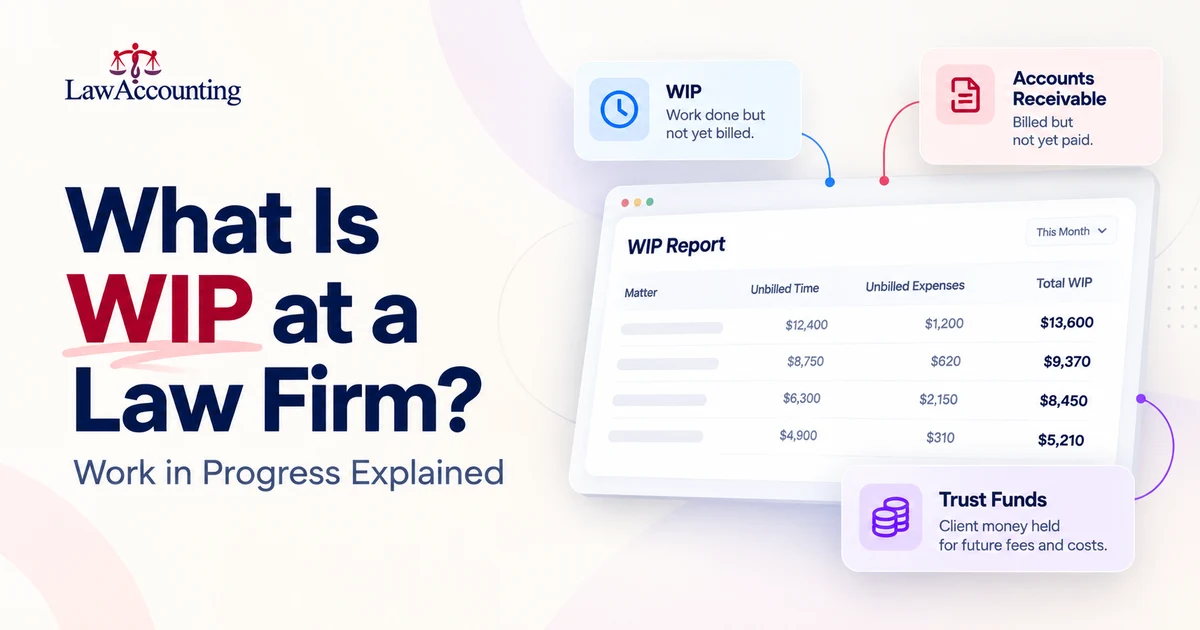
WIP, or work in progress, is the value of work a law firm has done but hasn't billed yet. It includes recorded time and expenses that haven't made it onto an invoice. Until WIP is billed, the firm can't collect it, so a high WIP balance means money is sitting in your billing system instead of your bank.
This guide explains how WIP differs from accounts receivable and trust funds, how to calculate WIP days and lockup with a worked example, how to read a WIP report, where WIP shows up in your books, and how to handle it on flat fee and contingency matters.
What is WIP at a law firm?
WIP is everything that's been worked but not yet billed. It usually includes:
- Unbilled time: hours recorded by attorneys and paralegals, valued at their billing rates
- Unbilled expenses: filing fees, expert costs, and other client costs paid but not yet invoiced
US firms often call it "unbilled time" or "unbilled fees." UK firms tend to say "WIP." It all means the same thing.
WIP is only as good as your time entries. Time that hasn't been recorded doesn't show up as WIP at all, so firms where attorneys enter time late usually have more WIP than their reports show.
What is the difference between WIP and accounts receivable?
WIP hasn't been billed. Accounts receivable (AR) has been billed but not yet paid. Trust funds are client money held for future fees and costs. Each one is a different stage of the same money.
| WIP | Accounts receivable | Trust funds | |
|---|---|---|---|
| Work done? | Yes | Yes | Not necessarily |
| Invoice sent? | No | Yes | No |
| Belongs to the firm? | Not until billed and paid | Yes, once paid | No, it's client money |
| Next step | Bill it | Collect it | Apply to invoices as fees are earned |
One point matters here for trust compliance. You can't move money out of trust to cover unbilled WIP. The work has to be billed first, and the transfer has to follow your engagement terms and your state's trust rules. Billing WIP on time is what lets you use retainers properly.
How do you calculate WIP days?
WIP days tell you how long, on average, work sits before it's billed. The common formula is:
WIP days = WIP balance ÷ annual fees billed × 365
AR days work the same way:
AR days = AR balance ÷ annual fees billed × 365
WIP days example
Here's a made-up mid-size firm, for illustration only:
| Amount | |
|---|---|
| Fees billed in the last 12 months | $6,000,000 |
| WIP balance today | $600,000 |
| AR balance today | $900,000 |
- WIP days: $600,000 ÷ $6,000,000 × 365 = about 37 days
- AR days: $900,000 ÷ $6,000,000 × 365 = about 55 days
- Total lockup: 37 + 55 = about 92 days
The firm bills about $16,400 per day on average ($6,000,000 ÷ 365). If it cut WIP days from 37 to 27 by billing faster, it would free up about $164,000 in cash without doing any more work.
Use a trailing 12 months of billed fees, not a single month, so seasonal swings don't throw off the number.
What is lockup in a law firm?
Lockup is the total time between doing the work and getting paid for it. It's WIP days plus AR days. In the example above, lockup is 92 days, so the firm is waiting about three months for its money.
Lockup is a cash flow measure, not a profit measure. A firm can be profitable and still run short on cash if lockup is high, because it pays salaries and rent every month while its fees come in months later.
WIP and realization
Not all WIP turns into cash. Some time gets written down before it's billed, and some billed fees are never collected. Realization measures how much survives each step:
Billing realization = fees billed ÷ value of time worked at standard rates
Collection realization = fees collected ÷ fees billed
If the firm in our example recorded $6,600,000 of time at standard rates and billed $6,000,000, its billing realization is about 91%. If it collected $5,700,000, its collection realization is 95%.
Old WIP tends to have lower realization. The longer work sits unbilled, the more likely a partner is to cut it or a client is to dispute it.
How to read a law firm WIP report
A WIP report lists unbilled time and expenses by client, matter, and timekeeper, usually grouped by age.
| Age of WIP | What it usually means |
|---|---|
| 0 to 30 days | Normal for firms that bill monthly |
| 31 to 60 days | Missed a billing cycle. Find out why. |
| 61 to 90 days | Likely stuck, often waiting on partner review |
| Over 90 days | High risk of write-down. Bill it or decide on it now. |
When you review the report, look for:
- Matters with large WIP and no recent invoice
- Partners whose matters carry much more WIP than others
- Unbilled expenses, which are easy to lose track of
- Flat fee or contingency matters mixed in with hourly ones, since they need to be read differently (see below)
Is WIP an asset on a law firm's balance sheet?
It depends on your accounting method.
On cash basis, WIP isn't recorded in the books at all. Income only shows up when a client pays, so WIP lives only in your billing system.
On accrual basis, many firms record WIP on the balance sheet as an asset, often in an account called unbilled fees or unbilled time. Some firms reduce it by an estimate of what won't be billed, so the balance sheet doesn't overstate it. Your CPA can tell you how to value and record WIP for your firm. Our law firm chart of accounts guide shows where an unbilled time account fits, and our guide to cash vs accrual accounting for law firms explains the difference between the two methods.
How does WIP work with flat fees and contingency cases?
Flat fee matters. The fee is set in advance, so time recorded on these matters isn't what you bill. Track it anyway. Comparing time spent to the flat fee shows whether the matter was profitable and helps you price the next one. Keep flat fee time out of your hourly WIP days calculation, or it will make billing look slower than it is.
Contingency matters. You can't bill until the case resolves, so time on these matters can sit for months or years. That's normal, but leave it out of your WIP days calculation for the same reason. Track it by matter anyway, since it shows how much the firm has invested in each case. Costs you advance on contingency matters should be tracked separately as client costs.
Should old WIP be written off?
Not automatically, but it shouldn't sit forever either. Set a rule, such as reviewing any WIP over 90 days at month-end. For each item, the responsible partner decides whether to bill it, write it down, or write it off, and records why.
Writing down WIP before billing reduces the amount you bill. It doesn't create an expense on cash basis, since that income was never recorded. On accrual basis, any WIP already recorded as an asset has to be reduced. Ask your CPA how to record write-downs in your books.
Managing WIP at a mid-size firm
At a firm with 20 to 100 users, WIP problems usually come from a few matters or a few partners, not from the whole firm. A few habits help:
- Review WIP monthly as part of month-end close, before invoices go out.
- Report WIP by partner and practice group, so it's clear where it's building up.
- Set a deadline for time entry, such as end of each week, so WIP reports are accurate.
- Give each matter one billing partner, who is responsible for reviewing and releasing its WIP.
- Track WIP days and lockup over time. There's no single industry standard for a good number, so compare your firm to its own history and by practice area.
Is WIP taxable for Canadian law firms?
Yes. Canadian lawyers used to be able to elect billed-basis accounting, which left unbilled WIP out of taxable income. The 2017 federal budget removed that option, and WIP was phased into income over five tax years. The CRA indicated that unbilled amounts on genuine contingency fee arrangements generally wouldn't be included until the firm has a right to the fee. Ask your accountant how this applies to your firm.
How LawAccounting fits
LawAccounting is our product, so read this with that in mind.
LawAccounting keeps billing, trust accounting, and the firm's books in one platform, with financial reporting down to the matter level. Because time, invoices, trust balances, and the general ledger share one system, you can see WIP, AR, and trust funds for a matter without pulling reports from separate tools.
FAQ
What is WIP at a law firm?
In a law firm, WIP (work in progress) is the value of billable time and expenses that have been recorded on matters but not yet invoiced to the client.
What does WIP stand for?
WIP stands for work in progress. In legal accounting it means work the firm has done but hasn't billed yet.
What is WIP in a company?
In most businesses, WIP means goods or projects that are started but not finished. In a law firm, it means unbilled time and expenses on open matters.
What is the difference between WIP and accounts receivable?
WIP is work that's done but not yet billed. AR (accounts receivable) is work that's been billed but not yet paid. WIP becomes AR when you send the invoice, and AR becomes cash when the client pays.
How do you calculate WIP days?
Divide your WIP balance by annual fees billed and multiply by 365.
What is a good WIP number for a law firm?
There's no official benchmark. Firms that bill monthly should see most WIP under 30 days old. Watch your own trend and compare by practice area.
Can I pay WIP from a client's trust account?
No. The work has to be billed first, and the transfer has to follow your engagement terms and trust rules.
How often should a law firm review its WIP report?
At least monthly, before invoices go out.
Is WIP taxable in Canada?
Yes. Since the 2017 federal budget, Canadian lawyers have had to include WIP in income, after a five-year phase-in.